

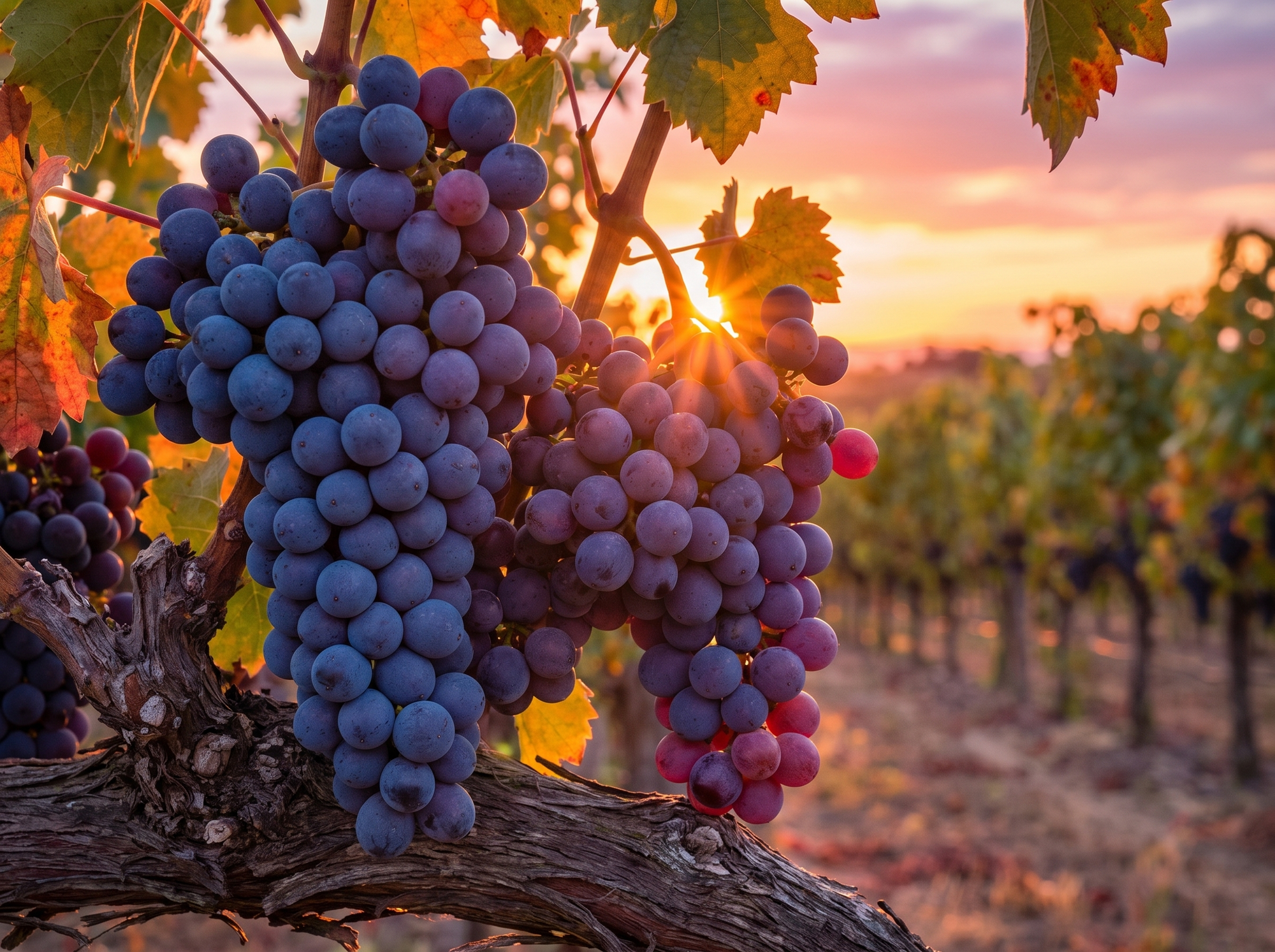
There's a good chance the last warm, juicy, spice-and-red-fruit red you drank was mostly Grenache — and that you had no idea. It's one of the most widely planted grapes on Earth, yet it spends most of its life uncredited, buried in a blend, going by a name you've probably never pronounced.
Why this matters
Most of us learn wine through big-name grapes: Cabernet, Merlot, Chardonnay. Grenache almost never gets its name on the front label, because it tends to work as part of a team. But once you learn to recognise its signature — that sweet-fruited, sun-soaked generosity — you start noticing it everywhere: in a Côtes-du-Rhône on a Tuesday, in a serious Priorat on a special night, in a rustic Sardinian red poured at a hundredth birthday party. This is the grape working quietly behind the scenes of your drinking life. It deserves a proper introduction.
One grape, three names
Part of the reason Grenache stays anonymous is that it travels under aliases. Follow it around the Mediterranean and it changes its passport at every border.
- Grenache — the French name, at home in the southern Rhône and across Languedoc-Roussillon.
- Garnacha — the Spanish name, and almost certainly the original. Grenache's roots are widely traced to the Aragón region of northern Spain.
- Cannonau — the name it carries on the island of Sardinia, where locals have long claimed it as their own.
Same grape, three identities, three cultures that each treat it as a birthright. That tug-of-war over its true home is a story in itself — but wherever it grows, its personality stays remarkably recognisable.
What Grenache tastes like
If a grape could be described as sunshine in a glass, this is it. Grenache ripens late and loves heat, packing on sugar under a fierce Mediterranean sun. That translates into wines that are high in alcohol, low in harsh tannin (the drying, grippy sensation you feel on your gums), and full of ripe, sweet-edged fruit.
Think strawberry and raspberry, sometimes stewed to the point of fig or dried cherry, laced with white pepper, dried herbs, and a warming note that some people describe as leather or licorice with age. It's a wine that feels generous — round, welcoming, easy to like — which is exactly why blenders lean on it to add flesh and warmth to firmer grapes.
Grenache is the grape that puts its arm around your shoulder. It doesn't lecture. It pours you another glass.
Where it lives: four homes worth knowing
The southern Rhône
This is Grenache's most famous stage. In Châteauneuf-du-Pape and across the broader Côtes-du-Rhône, it's usually the backbone of a blend, softened and spiced by Syrah and Mourvèdre — the trio wine people shorthand as "GSM." Here Grenache brings the sweetness and body; its partners bring structure and colour.
Aragón and beyond, in Spain
In its likely homeland, old Garnacha vines — some of them ancient, gnarled bush vines — produce concentrated, characterful reds. Regions like Campo de Borja and Calatayud have quietly become some of the best value for money in the wine world.
Priorat
In this rugged corner of Catalonia, Garnacha grows on steep slopes of black slate the locals call llicorella. The poor soil and punishing terrain force the vines to struggle, yielding tiny quantities of dense, mineral, powerful wine. This is Grenache in serious, age-worthy mode.
Sardinia
As Cannonau, Grenache produces the everyday red of the island — and here it takes on a fascinating extra dimension.
The Blue Zone connection
Sardinia is one of the world's so-called Blue Zones — regions with unusually high numbers of people living past 100. Cannonau is woven into daily life there, and it's often mentioned in that longevity conversation because of its rich content of polyphenols, the natural antioxidant compounds found in grape skins.
It's worth being honest here: no wine is a health tonic, and the science points to lifestyle as a whole — diet, movement, community, and moderation — rather than any single glass. What's genuinely interesting is the cultural picture: modest amounts of local red enjoyed slowly, with food and company, as part of a life built around connection. That's the real lesson, and it's a lovely one.
Where to start
You don't need to spend much to meet Grenache properly. A few routes in:
- A Côtes-du-Rhône for the classic, food-friendly blended style.
- A Garnacha from Campo de Borja or Calatayud for pure, unfussy fruit at a friendly price.
- A Cannonau di Sardegna if you want to taste the Blue Zone story for yourself.
- A Priorat when you're ready to see how serious this grape can get.
Pour it slightly cool rather than warm — around 16°C — and give it a big glass and a little air. It shines alongside roasted meats, herby stews, grilled vegetables, and anything that tastes of the Mediterranean.
Powered by Corkified
Next time you open a southern French or Spanish red, scan the bottle with Corkified before you pour — and find out whether the grape you've been drinking all along was Grenache in disguise.