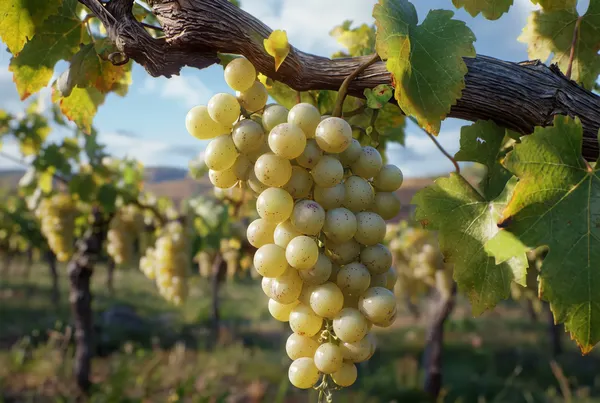


Burgundy’s other white grape, long dismissed as sharp filler, is finally taken seriously.
At a Glance
Aligoté (say ah-lee-go-TAY) is the white grape that lives in Chardonnay’s shadow in Burgundy. It makes lean, sharp, high-acid whites that historically got little respect, planted on the poor sites while the good slopes went to Chardonnay. That is changing. A handful of producers now make serious, age-worthy Aligoté, and prices have climbed. France grows about 4,400 to 4,900 acres (1,800 to 2,000 hectares), almost all in Burgundy, though far larger plantings sit in Eastern Europe.
Color: White
Also known as: No label synonym; two biotypes, Aligoté Doré and Aligoté Vert
Origin: Burgundy, France
Where it grows best: Bouzeron and the Côte Chalonnaise (Burgundy); also Moldova, Ukraine, Russia
Signature flavors: Green apple, lemon, white flowers, crushed stone
Body & style spectrum: Lean and tart, rarely rich
What It Tastes Like
Aligoté is built on acidity. Expect sharp green apple, fresh lemon, a hint of white flowers, and a stony finish. The body is light, and the wine is usually dry and unoaked, which keeps it crisp. Where Chardonnay can be broad and creamy, Aligoté stays taut and lean.
It ripens with high natural acidity and modest sugar, so alcohol tends to be moderate. In cool years or from poor sites it can be austere and green, almost biting. From good sites, low yields, and older vines, it gains texture and a saline depth that surprises people who wrote it off. Some producers now use a little oak or lees aging, meaning time resting on spent yeast, to round it out, though the classic style is fresh and unadorned.
How to tell it apart: the confusion is with unoaked Chardonnay, its Burgundian neighbor and half-sibling. Chardonnay is rounder and riper, with orchard fruit and often a creamy note. Aligoté is leaner and greener, more overtly citric and stony. If a white Burgundy tastes bracingly tart and simple rather than plush, it is likely Aligoté.
Where It Grows
Homeland: Burgundy, where Aligoté is the second white grape after Chardonnay but under 6% of the vineyard. Most goes into the regional Bourgogne Aligoté appellation, a legally defined category for the variety. The quality benchmark is Bouzeron, a village in the Côte Chalonnaise and the only village-level appellation in Burgundy reserved for Aligoté; it uses the finer, smaller-berried Aligoté Doré biotype, meaning a naturally occurring sub-type of the variety. Beyond France, Aligoté is widely planted across Eastern Europe. Moldova, Ukraine, and Russia grow large amounts for simple dry whites and sparkling base wine, though those bottles rarely reach export markets.
In the Vineyard and Cellar
Aligoté buds and ripens early and tolerates cold well, which suited it to Burgundy’s marginal, frost-prone sites, even as early budding leaves it exposed to spring frost. It is vigorous and can overcrop, meaning it sets more fruit than it can ripen well and dilutes flavor unless the grower cuts yields. That vigor earned its bulk-wine reputation. Handled carefully, on the right slope with low yields, it makes something far more serious. Most is fermented in steel to preserve the bright acidity.
Reading the Label
Aligoté is one of the rare Burgundian wines named for its grape. Look for “Bourgogne Aligoté,” the regional appellation for the variety anywhere in Burgundy. The single exception at village level is Bouzeron, always 100% Aligoté even though the grape is not printed. Outside France, Eastern European bottles usually name the grape. There is no US varietal tradition to speak of, so you will rarely see a domestic one.
A Short History
DNA fingerprinting in 1999 confirmed Aligoté is a natural cross of Pinot and Gouais Blanc, the same pairing that produced Chardonnay, which makes the two full siblings. Aligoté has grown in Burgundy since at least the 1600s. For most of its history it played second fiddle, valued for acidity rather than prestige, until modern growers began treating it as a wine worth aging.
Did you know? The classic French aperitif Kir, white wine mixed with blackcurrant liqueur, was traditionally made with Bourgogne Aligoté. It took its name from Félix Kir, a canon and the mayor of Dijon after World War II, who popularized the drink.
At the Table
Aligoté’s high acidity makes it a natural aperitif and a fine match for briny and rich food. It is the traditional partner for Burgundian gougères, cheese puffs made with choux pastry, and it works with oysters, snails in garlic butter, and other shellfish, where the sharp acid cuts through butter and cream. Goat cheese, fried fish, and charcuterie suit it too. It is not a wine for big or spicy dishes. Serve it well chilled, around 45°F (7°C). Most Aligoté is made to drink young and fresh within a few years, though the best Bouzeron can age five to ten years and gain a honeyed depth.
SOURCING & METHOD
Sourcing: origins, parentage, and synonyms drawn from Robinson, Harding & Vouillamoz, Wine Grapes (2012), the Vitis International Variety Catalogue, and peer-reviewed parentage studies; planting figures from OIV, the University of Adelaide winegrape database, national bodies, and Wine-Searcher, each anchored to a stated year; regional detail from the relevant consortia and D'Agata's Native Wine Grapes of Italy. Every fact was corroborated by at least two independent sources.