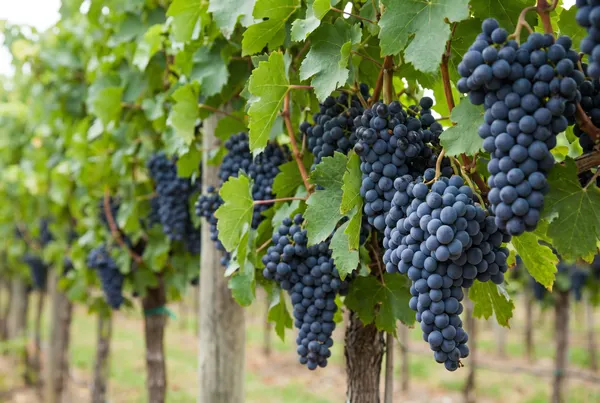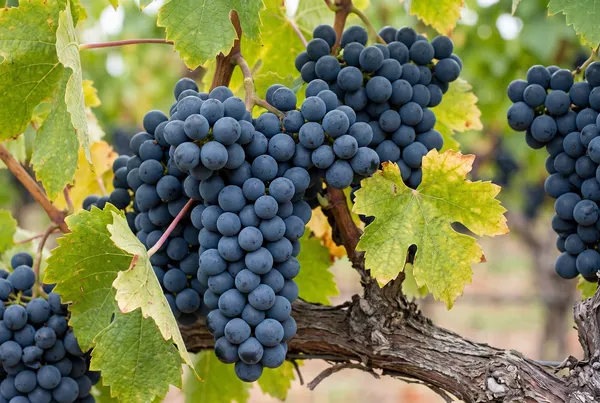


The Spain's red grape answer to Bordeaux, aged so long in oak it tastes of leather and dill.
1 AT A GLANCE
Tempranillo ripens early; the name comes from temprano, Spanish for "early." It carries moderate acidity and a firm backbone, and it takes to oak like few other reds, which is why so much of it spends years in barrel before release. Spain grows the overwhelming majority, roughly 87% of the world's total, and in 2022 Tempranillo became the country's most-planted grape of any color, ahead even of the white workhorse Airén. Its second home is Portugal, where it hides under other names and helps build both dry reds and Port.
COLOR: Black
ALSO KNOWN AS: Tinto Fino / Tinta del País (Ribera del Duero), Cencibel (La Mancha), Tinta de Toro (Toro), Tinta Roriz / Aragonez (Portugal)
ORIGIN: North-central Spain (Ebro Valley); a cross of Albillo Mayor × Benedicto
GROWS BEST: High, continental plateaus: Rioja, Ribera del Duero, Toro
SIGNATURE FLAVORS: Red plum, dried cherry, fig, tobacco, leather; dill and coconut from American oak
BODY & STYLE: Medium-bodied and bright to dense and powerful; often heavily oak-aged
2 WHAT IT TASTES LIKE
Medium body, medium acidity, and medium-to-firm tannin, the drying grip that comes from skins and seeds. The fruit is red plum, dried cherry, and fig, never especially loud. What defines Tempranillo is the barrel. Traditional Rioja ages it in American oak, which gives coconut, sweet vanilla, and an unmistakable dill note; modern producers and the growers of Ribera del Duero prefer French oak for a tighter, darker spice. With bottle age the wine turns to leather, tobacco, and dried herbs, and the color fades toward brick. High, cool Ribera del Duero makes firmer, darker, more concentrated wine; warm La Mancha makes it soft and fruity for early drinking. In Rioja it is often blended with Garnacha for flesh and with Graciano for acidity and lift.
How to tell it apart: blind, Tempranillo gets mistaken for Sangiovese or Cabernet Sauvignon. Its tell is that American-oak dill and coconut wrapped around dried strawberry and leather in classic Rioja. It's less searingly acidic than Sangiovese, which drives sour cherry and tomato leaf, and it's rounder and less green than Cabernet, which shows blackcurrant and bell pepper.
3 WHERE IT GROWS
Rioja is the classic address, split between the cooler, higher Rioja Alta and Rioja Alavesa, which give structured, age-worthy wine, and the warmer Rioja Oriental, which ripens fatter fruit. Ribera del Duero sits high on the Castilian plateau, near 2,800 feet (850 meters), where big day-to-night temperature swings preserve acidity; there Tempranillo goes by Tinto Fino or Tinta del País and reaches its most powerful, as in the cult wines of Vega Sicilia. Toro pushes it riper and denser as Tinta de Toro. In Portugal it is Tinta Roriz in the Douro and Dão and Aragonez in the Alentejo, lending structure to Port and to dry reds alike. Growers have planted it in Argentina, Australia, and the United States as well, though nowhere abroad has it become a headline grape.
4 IN THE VINEYARD AND CELLAR
Tempranillo buds early and ripens early, a double exposure that leaves it open to spring frost and, in hot years, to raisining on the vine. Its thin-to-medium skins rot in damp weather, so it favors dry continental air and poor soils that curb its natural vigor; the canes can run to 16 feet (about 5 meters) if left unchecked. Because the fruit is fairly neutral and the acidity only moderate, producers built an entire culture of oak and time around the grape. The legal tiers, Crianza, Reserva, and Gran Reserva, each set a minimum stretch in barrel and bottle, and that mandated aging supplies the leather-and-spice complexity the fruit alone won't deliver.
5 READING THE LABEL
The grape changes names by region, and Spain's famous wines usually print the place, not the variety: Rioja and Ribera del Duero simply are Tempranillo. Portugal uses Tinta Roriz or Aragonez. The aging words matter as much as the grape name: Crianza means roughly two years' aging with time in oak, Reserva about three, and Gran Reserva five or more, so those terms describe maturity and oak rather than what's in the bottle. As with any US varietal wine, "Tempranillo" on an American label guarantees only 75% of the grape.
6 A SHORT HISTORY
For years people guessed Tempranillo was a relative of Pinot Noir. DNA work in 2012 ended that idea: its parents are Albillo Mayor, a white grape still grown in central Spain, and Benedicto, a nearly forgotten one, with the Ebro Valley as the likely cradle. In 1858 the founder of Marqués de Riscal hired a Bordeaux cellar master, and the French barrel-and-aging template took root in Rioja.
Did you know? The coconut-and-dill scent in classic Rioja isn't the grape at all. It's American oak. Spanish cellars favored American barrels for a century, and the wood's lactones give that sweet, sappy signature.
7 AT THE TABLE
Firm tannin and savory fruit call for protein and roast flavors: lamb, suckling pig, jamón, grilled steak, aged Manchego cheese. The moderate acidity handles moderate richness without cutting as hard as an Italian red would, and the oak-sweet edge of Rioja loves smoke from a grill. Serve at 60–64°F (16–18°C). A young Crianza is ready the day you buy it; Reserva and Gran Reserva can run 10 to 20 years or more, softening into leather and dried fruit. A Gran Reserva Rioja, often under $30, is one of the few properly mature red wines an ordinary drinker can afford at all.
SOURCING & METHOD
Sourcing: origins, parentage, and synonyms drawn from Robinson, Harding & Vouillamoz, Wine Grapes (2012), the Vitis International Variety Catalogue, and peer-reviewed parentage studies; planting figures from OIV, the University of Adelaide winegrape database, national bodies, and Wine-Searcher, each anchored to a stated year; regional detail from the relevant consortia and D'Agata's Native Wine Grapes of Italy. Every fact was corroborated by at least two independent sources.