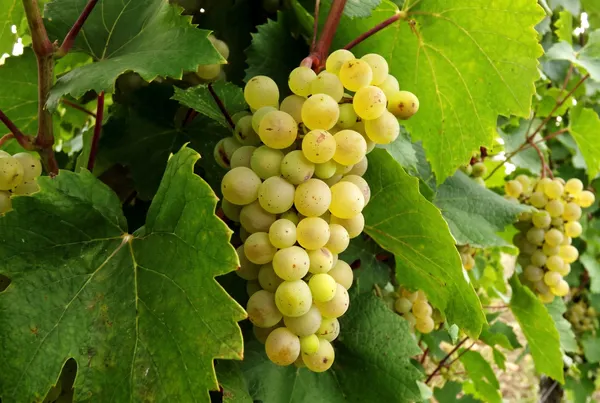


The Hungarian white grape behind Tokaji, a noble-rot sweet wine older than Sauternes.
1 AT A GLANCE
Furmint holds acidity like almost no other white, which lets it swing from bone-dry to intensely sweet without ever tasting flabby. It's Hungary's signature grape, grown mostly in the Tokaj region, and it forms the base of Tokaji Aszú, a sweet wine made from grapes shriveled by noble rot. Noble rot is a benevolent form of the fungus Botrytis cinerea that pierces the skin, dehydrates the berry, and concentrates its sugar and acid into something extraordinary.
COLOR: White
ALSO KNOWN AS: Šipon (Slovenia), Moslavac (Croatia), Mosler (Austria)
ORIGIN: Tokaj, northeast Hungary; offspring of Gouais Blanc
GROWS BEST: The volcanic hills of Tokaj; also Somló
SIGNATURE FLAVORS: Green apple, quince, lime, pear, smoky flint; honey and orange marmalade when sweet
BODY & STYLE: Bone-dry and steely to lusciously sweet and long-aging
2 WHAT IT TASTES LIKE
The defining trait is very high acidity, the kind that makes your mouth water and keeps even the sweet versions lively. Dry Furmint shows green apple, quince, lime, and pear over a smoky, flinty streak that comes from Tokaj's volcanic soil; barrel-aged bottles gain a waxy weight and a nutty depth. Sweet Aszú turns to dried apricot, honey, and orange marmalade, always cut by that searing acidity so it finishes clean rather than cloying.
How to tell it apart: Furmint is most often confused with Riesling, since both are high-acid, mineral, capable of noble-rot sweetness, and built to age for decades. Furmint is broader and waxier, with quince and pear and that smoky edge; Riesling is more overtly floral and citrus-driven and develops a petrol or kerosene note with age that Furmint doesn't share. If a dry white is mineral and sharp but not floral, lean toward Furmint.
3 WHERE IT GROWS
Tokaj is the heartland, its volcanic and loess soils and river-fed autumn mists feeding both crisp dry whites and the great Aszú. Somló, a lone extinct volcano in western Hungary, gives smoky, austere dry Furmint from basalt. Beyond Hungary, Slovenia grows it as Šipon and Croatia as Moslavac, almost always as dry wine. That is nearly the whole map: Furmint barely travels. Hungary holds the vast majority, roughly 9,000 to 10,000 acres (about 3,500 to 4,000 hectares) as of the early 2020s, most of it inside Tokaj.
4 IN THE VINEYARD AND CELLAR
Furmint buds early, so spring frost is a real threat, and it ripens late. Its loose bunches and thinnish skins make it a magnet for noble rot in Tokaj's damp autumns, where the Bodrog and Tisza rivers breed the morning fog that spreads the fungus. For Aszú, pickers go through the vineyard by hand and select only the shriveled, rot-touched berries, then steep them in a base wine to leach out the concentrated sugar. For dry styles, growers work the canopy hard to keep the fruit clean and rot-free, which asks for nearly the opposite vineyard management in the same rows.
5 READING THE LABEL
Tokaji tells you the place and often the style. Aszú means sweet, graded by "puttonyos" or by sugar level; Szamorodni is a different traditional style; a bottle marked "Dry Tokaji" is exactly that. Slovenian labels read Šipon. Furmint is frequently blended with Hárslevelű, a grape it happens to have fathered, which adds perfume. A US buyer will rarely meet a synonym on the shelf.
6 A SHORT HISTORY
Furmint was recorded by name in Tokaj in 1611. DNA shows Gouais Blanc as one parent, which makes Furmint a half-sibling of Chardonnay and Riesling; the second parent is unknown and probably extinct. Decades of communist-era bulk production dragged quality down, and a revival in the 1990s, helped by outside investment, brought serious dry Furmint to the world.
Did you know? Tokaji Aszú was documented as a noble-rot sweet wine by the 1570s, well before Sauternes in France or the sweet wines of Germany established the style. On this one, Hungary got there first.
7 AT THE TABLE
Dry Furmint's electric acidity slices through roast chicken, pork, river fish, and cream sauces, and it can even stand up to a little chili heat. Sweet Aszú needs a partner with its own richness or salt: blue cheese, foie gras, or a custard-based dessert, since a sweet wine wants a sweet or salty-rich plate beside it. Serve dry Furmint at 48–50°F (9–10°C) and Aszú a touch colder. Dry versions age a decade with ease; a great Aszú can outlive the person who bought it. Dry Furmint is, to my palate, the most underpriced serious white on the market right now.
SOURCING & METHOD
Sourcing: origins, parentage, and synonyms drawn from Robinson, Harding & Vouillamoz, Wine Grapes (2012), the Vitis International Variety Catalogue, and peer-reviewed parentage studies; planting figures from OIV, the University of Adelaide winegrape database, national bodies, and Wine-Searcher, each anchored to a stated year; regional detail from the relevant consortia and D'Agata's Native Wine Grapes of Italy. Every fact was corroborated by at least two independent sources.