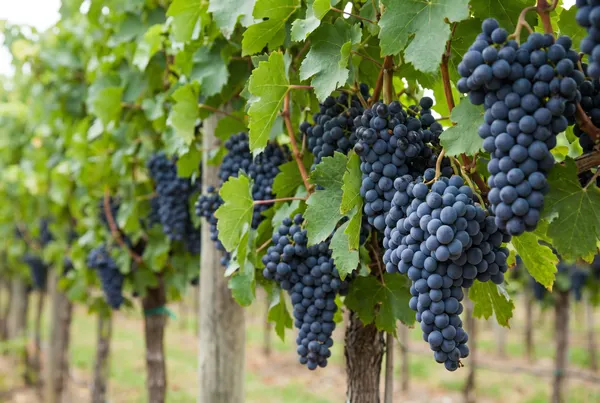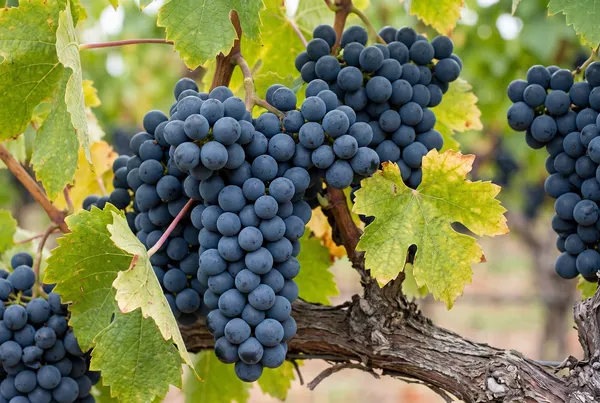


Pale as Pinot, punishingly tannic, and the grape behind Barolo's tar and roses.
1 AT A GLANCE
Nebbiolo makes Barolo and Barbaresco, two of Italy's longest-lived reds. The grape is a paradox: pale and light-colored, much like Pinot Noir, yet loaded with tannin and acidity that can take decades to soften. Its perfume of dried roses, tar, and cherry is unlike anything else in wine. It is fussy about where it will ripen and barely leaves its corner of northwest Italy, so for all its fame it remains a small-production grape.
COLOR: Black, but low in pigment, so the wine is pale
ALSO KNOWN AS: Spanna (northern Piedmont), Chiavennasca (Valtellina), Picotener (Carema)
ORIGIN: Piedmont and Valtellina, Italy; ancient, parents unknown
GROWS BEST: South-facing limestone hills of the Langhe: Barolo, Barbaresco
SIGNATURE FLAVORS: Dried rose, tar, sour cherry, licorice, truffle, dried herbs
BODY & STYLE: Always high-acid and high-tannin; perfumed and lighter (Barbaresco) to dense and brooding (Barolo)
2 WHAT IT TASTES LIKE
Light-to-medium body, very high acidity, very high tannin (the drying grip from skins, seeds, and stems), and a pale garnet color that turns orange at the rim early in its life. The nose is the signature: dried rose petal, tar or bitumen, sour cherry, licorice, star anise, and truffle. The color is a decoy, because the wine looks delicate and then grips hard and finishes long. Traditional long-aged styles show dried fruit, leather, and forest floor; modern winemaking gives fresher fruit and rounder tannin through shorter skin contact and French oak.
How to tell it apart: Nebbiolo is confused with Pinot Noir by sight and with Sangiovese by structure. Against Pinot, it carries far more tannin, plus the tar and dried-rose notes Pinot never shows. Against Sangiovese, it's more floral and perfumed with even higher tannin, where Sangiovese runs on sour cherry and a savory tomato-leaf edge. When a pale red almost strips the moisture from your gums, think Nebbiolo.
3 WHERE IT GROWS
Barolo is the biggest and most tannic expression, and its villages fall into two camps: Serralunga and Monforte give firmer, more structured wine, while La Morra and Barolo village give something more perfumed and silky. Barbaresco, moderated by the nearby Tanaro river, ripens a little earlier and is a touch less tannic and more approachable young; its vineyard area reached about 1,800 acres (733 hectares) by 2019, and Barolo is more than twice as large. Roero, across the river, and the broader Langhe Nebbiolo and Nebbiolo d'Alba bottlings offer lighter, earlier-drinking value. In northern Piedmont, Gattinara and Ghemme make firm, mineral wine from the grape under the name Spanna, and in Lombardy's alpine Valtellina it is Chiavennasca, grown on terraces and even dried for the concentrated Sforzato style.
4 IN THE VINEYARD AND CELLAR
Nebbiolo buds early and ripens very late, into mid-to-late October after the autumn fog has rolled into the Langhe, so it fully ripens only on the warmest, south-facing sites. That greed for the best exposures is precisely why it pushes Barbera and Dolcetto downhill onto lesser slopes. Its thin skins give little color but a heavy load of tannin drawn from skins, seeds, and stems, which is why the wine is pale yet fierce. Long aging in oak, traditionally in large old casks, is standard practice to tame that tannin before a bottle is ever released for sale.
5 READING THE LABEL
The famous wines are named for place, not grape: Barolo, Barbaresco, Gattinara, Ghemme. "Langhe Nebbiolo" and "Nebbiolo d'Alba" name the grape directly and cost far less, making them the smart way to learn its taste without paying Barolo prices. Spanna in northern Piedmont and Chiavennasca in Valtellina are the same variety under local names. Barolo and Barbaresco both carry mandatory minimum aging before release, so even a young vintage on the shelf has already spent years resting in a cellar.
6 A SHORT HISTORY
Nebbiolo is ancient, tied to Piedmont since at least the 1200s. Its parents have never been found and may be extinct, but the grape is the parent of Freisa and Vespolina, and DNA work in 2004 turned up a surprising distant kinship with Viognier, the perfumed white grape of the northern Rhône. The name most likely comes from nebbia, the Italian word for the fog that fills the Langhe at harvest.
Did you know? Nebbiolo, a brooding and tannic red, is genetically related to Viognier, the floral white of the northern Rhône. DNA research in 2004 linked the two, an unlikely pairing of near-opposites in one family tree.
7 AT THE TABLE
High acid and high tannin demand rich, fatty food with plenty of protein, because the tannin binds to fat and protein and softens against them. The classics are Piedmontese: brasato al Barolo (beef braised in the wine itself), risotto with butter and truffle, braised meats, aged cheese, and mushroom dishes. Set it beside something delicate or lightly acidic and the food simply disappears. Serve at 62–66°F (17–19°C), and decant young bottles for an hour to let the tannin unwind. Barolo and Barbaresco reward 10 to 25 years; Langhe Nebbiolo drinks far sooner. Young Barolo is usually a waste of money, because this is a wine that punishes impatience.
SOURCING & METHOD
Sourcing: origins, parentage, and synonyms drawn from Robinson, Harding & Vouillamoz, Wine Grapes (2012), the Vitis International Variety Catalogue, and peer-reviewed parentage studies; planting figures from OIV, the University of Adelaide winegrape database, national bodies, and Wine-Searcher, each anchored to a stated year; regional detail from the relevant consortia and D'Agata's Native Wine Grapes of Italy. Every fact was corroborated by at least two independent sources.