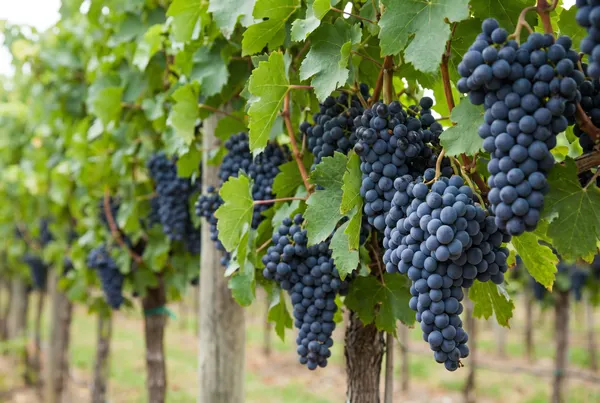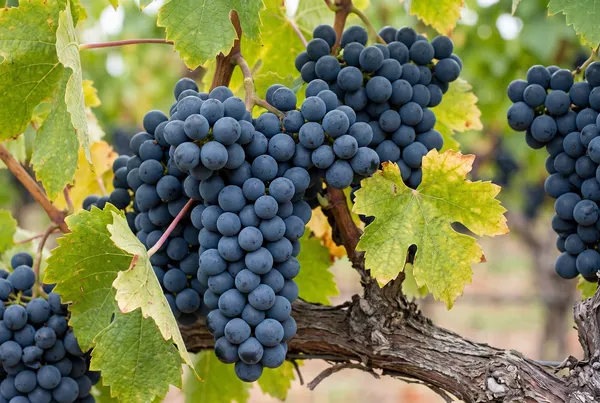


Portugal's flagship red, small-berried and low-yielding, behind both Port and its most ambitious dry wines.
At a Glance
Touriga Nacional is the grape Portugal points to when it wants to impress. It gives structure, deep color, and floral intensity to Port, the fortified wine of the Douro Valley, and increasingly it makes powerful dry reds on its own. Yields are tiny and the wines are dense, which is both why it was nearly abandoned and why it is now prized.
Color: Black
Also known as: Touriga (short form); Tourigo do Dão (historical)
Origin: Northern Portugal; the Dão and Douro both claim it
Grows best in: The Douro and Dão, Portugal
Signature flavors: Blackberry, blueberry, black plum, violet, bergamot; a note of mint or rockrose
Body & style: Fresh, floral, mid-weight reds, through to dense oak-aged bottlings and Port. Full-bodied, high tannin.
What It Tastes Like
Touriga Nacional hits with color, perfume, and grip at once. The wine is nearly opaque. The nose is intensely floral, violets and bergamot orange, over blackberry, blueberry, and black plum, often with a lift of mint, pine, or the resiny rockrose scrub of the Douro hills. On the palate it is full-bodied, with high tannin (the firm drying compound from skins that gives red wine its structure and aging capacity) and enough acidity to stay fresh.
Climate and handling shift it. In cooler Dão sites it can be more elegant, floral, and mid-weight. In the hot Douro it turns denser and more powerful. New oak, which many producers use, layers in vanilla, cedar, and smoke and softens the edges. Alcohol tends to run high, and the best producers rein it in to keep the perfume from turning jammy.
How to tell it apart: the constant comparison is to its own offspring, Touriga Franca (Touriga Francesa). The English wine writer Jancis Robinson likens the pair to Cabernet Sauvignon and Cabernet Franc: Touriga Nacional supplies structure and floral power, Touriga Franca fills in fruit and perfume. Nacional is the more concentrated, more tannic, more violet-scented of the two. Against a Napa Cabernet, which it can resemble in weight, Touriga is more floral and less blackcurrant. It earns the flagship billing Portugal gives it.
Where It Grows
Two regions claim it, and DNA has not fully settled the argument, though the Dão shows greater genetic diversity of the grape, which hints at older roots there. Both matter today.
In the Douro Valley, on steep schist terraces, it is a cornerstone of Port and of the serious dry reds that have made the Douro a fine-wine region in its own right; here it is powerful and dense. In the Dão, on granite at altitude, it leans floral and refined. It has since spread across Portugal, into the Alentejo, the Tejo, and beyond, and abroad to Australia, California, and South Africa, though those plantings stay small. By the early 2020s it covered well over 10,000 hectares (about 25,000 acres) in Portugal, the Douro and Dão holding the largest shares, a striking comeback for a grape once judged not worth planting.
In the Vineyard and Cellar
The grape has thick skins and very small berries, which concentrate color, tannin, and flavor but also mean naturally low yields. That stinginess nearly killed it: by the mid-20th century growers were abandoning it because it did not pay. A clonal selection program from the 1970s, isolating and propagating the best-performing vines, rescued it by improving its yields and reliability without losing quality. The vine is vigorous and needs canopy management. In the cellar it takes extraction and new oak well, which is why so many ambitious dry reds lean on it.
Reading the Label
On a dry wine it reads Touriga Nacional, either as a single variety or heading a blend. It is the backbone of countless Douro and Dão reds and appears, unnamed, in Port, where blends of local grapes are the norm and varieties rarely reach the label. A US varietal wine needs 75% of the grape; abroad, a bottle labeled Touriga Nacional from Australia or California signals a producer chasing the Portuguese benchmark. In Portugal, the best dry examples name both the grape and the region. In Port, the trade prizes it as the most valuable of the roughly five grapes it favors most, ahead of partners like Touriga Franca and Tinta Roriz.
A Short History
Touriga Nacional is native to northern Portugal, documented for centuries in the Dão and Douro. Its own parentage is unknown, but DNA has shown it is a parent of Touriga Franca, the Douro's most-planted grape, crossed with the obscure Marufo. Nearly discarded for its meager yields, it was saved by clonal selection and now sits at the center of Portugal's modern red-wine ambitions. The Douro's shift from fortified Port toward serious dry table wine, gathering pace from the 1990s, leaned heavily on this grape.
Did You Know? Touriga Nacional was almost given up on. Its yields were so small that mid-20th-century growers found it barely worth planting. Only a program to select and multiply its best vines, begun in the 1970s, made it viable again and cleared the way for it to become Portugal's signature red.
At the Table
Serve it at 60 to 64°F (16 to 18°C). This is a big tannic red that wants rich protein: roast lamb, grilled beef, game, duck, and hearty braises. The tannin cuts fat while the floral lift keeps it from feeling heavy. Portuguese classics like roast kid or a lamb pie are natural matches. Young single-variety bottlings can be tight and oaky, so decant them. The best age well for a decade or more, softening as the tannins settle and the fruit turns to dried plum and spice. Port made from it is a dessert in itself.
SOURCING & METHOD
Sourcing: origins, parentage, and synonyms drawn from Robinson, Harding &
Vouillamoz, Wine Grapes (2012), the Vitis International Variety
Catalogue, and peer-reviewed parentage studies; planting figures from OIV, the
University of Adelaide winegrape database, national bodies, and Wine-Searcher,
each anchored to a stated year; regional detail from the relevant consortia and
D'Agata's Native Wine Grapes of Italy. Every fact was corroborated by at
least two independent sources.