

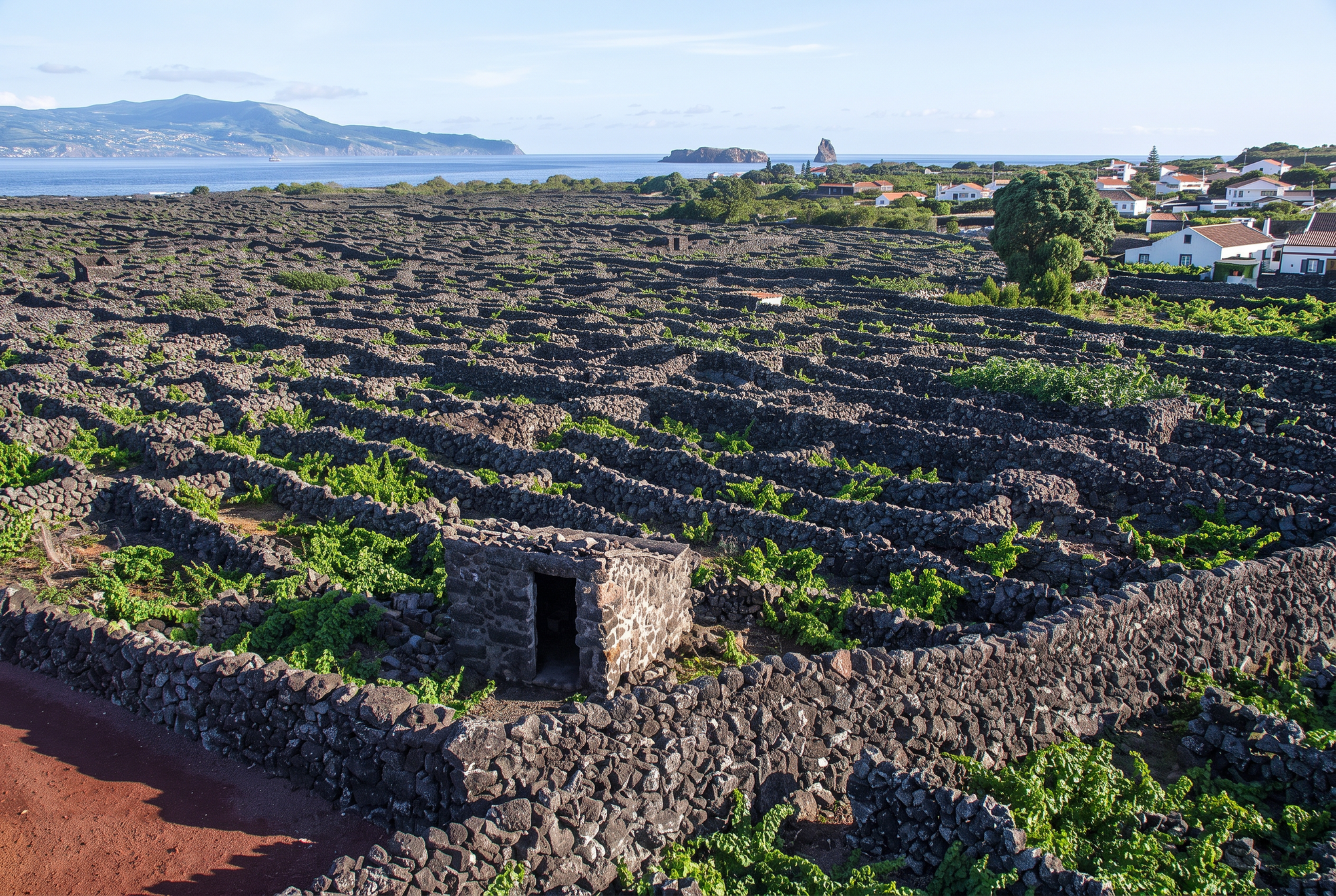
Vines ripen inside hand-stacked lava corrals on nine islands in the open Atlantic.
1. At a Glance
Nine volcanic islands sit about 900 miles (1,450 kilometers) west of Lisbon, and on three of them wine has been coaxed from bare basalt for five centuries. Growers plant vines in cracks in the lava and shield them behind low black stone walls. The result is a tiny production of saline, high-acid whites that taste like nowhere else in Portugal, and that have gone from local curiosity to sommelier obsession in barely a decade.
Country: Portugal (Autonomous Region of the Azores)
Main grapes: Verdelho, Arinto dos Açores, Terrantez do Pico (white)
Signature styles: Bone-dry, salty whites; traditional fortified whites
Climate: Maritime; mild, humid, wind-battered, with high rainfall
Key appellations: DOs Pico, Graciosa, and Biscoitos; IG Açores
Vineyard area Small; the UNESCO-listed core on Pico covers 987 hectares (2,440 acres)
2. Why It Matters
The Azores matter for how the wine is grown as much as how it tastes. The vineyard landscape of Pico, a lattice of thousands of tiny stone corrals built by hand from volcanic rock, was inscribed as a UNESCO World Heritage Site in 2004. After near-extinction in the 19th century, the islands' native grapes are now behind some of Portugal's most sought-after white wines.
3. Land and Climate
Everything here follows from two facts: the soil is lava and the wind never stops. There is little true topsoil, so vines root directly into fissures in black basalt. To protect them from Atlantic gales and salt spray, generations of farmers stacked loose volcanic stone into small rectangular enclosures called currais, built without mortar, each sheltering a few vines trained low along the ground. On Pico, the vineyards run along the shore at the foot of the island's volcanic cone, the highest summit in all of Portugal, and the contrast of black rock, green vine, and open ocean is unlike any other wine landscape.
The walls do double duty. They block the wind, and the dark stone soaks up sun and radiates heat back at the grapes, a homemade greenhouse effect in a cool, damp climate. Vines are trained low, sprawling across the warm rock in a system locals call chão, and every task from pruning to picking is done by hand; no machine fits inside a curral. The ocean keeps temperatures mild year-round and humidity high, so ripeness comes slowly and acidity stays vivid. That tension, ripe fruit over a streak of salt and volcanic bite, is the Azorean signature.
4. Grapes and Styles
Whites rule. Verdelho, the historic grape (a different variety from Spain's Verdejo), makes dry whites with citrus and sea-spray character, and it once supplied the islands' famous fortified wines. Arinto dos Açores, a local variety distinct from mainland Arinto, gives piercing acidity and stony intensity. Terrantez do Pico was down to a handful of surviving plants before growers rescued it; it is now the collector's grape.
Each certified island has a lean. Pico is the engine, with the largest plantings and the boldest new projects. Graciosa historically makes lighter, fresh dry whites. Biscoitos, on Terceira, keeps the old fortified tradition alive. Alongside all of this runs vinho de cheiro, a rustic, strawberry-scented wine from hybrid grapes planted after the 19th-century plagues; it never leaves the islands, but it still flows at village feasts.
Styles run from crisp, unoaked whites meant for seafood to fuller versions fermented in old casks or on their skins, plus small amounts of traditional fortified wine (wine strengthened with grape spirit) on Pico and in Biscoitos. Reds exist but stay local. My view: Arinto dos Açores, not the better-known Verdelho, makes the archipelago's most electric wines.
5. Reading the Label
Three names carry the DO, Portugal's controlled designation of origin: Pico, Graciosa, and Biscoitos (a village zone on Terceira island). These certify wine from delimited zones on those islands under stricter rules.
Most bottles you will actually find abroad carry "IG Açores" or "Vinho Regional Açores," the broader regional category covering all nine islands; nearly all of the celebrated modern producers use it because it allows more freedom. "Licoroso" on a label means fortified. A subregion or island name plus a grape, for example "Arinto dos Açores, IG Açores," is the fastest way to know what is in the glass. Expect small quantities and rising prices; production is tiny by mainland standards, and demand has outrun it.
6. A Short History
Settlers planted vines on Pico in the late 15th century, and by the 1800s the islands were shipping white wine across Europe and the Atlantic. Then two imported vine plagues, the powdery-mildew fungus and the phylloxera root louse, destroyed almost everything. Vineyards shrank to a remnant, and hybrids for local drinking took over. UNESCO recognition in 2004 and a wave of quality-minded producers from the 2010s onward rebuilt the vineyards and the reputation.
Did You Know? The vineyard landscape of Pico, a UNESCO World Heritage Site since 2004, protects 987 hectares of coastal plots divided by mile after mile of hand-stacked basalt walls, built without any mortar. From above, the pattern looks like a vast black net thrown over the island's shore.
7. At the Table
These are seafood whites, full stop. Pour them at 46 to 50°F (8 to 10°C) with the local classics: lapas (grilled limpets with garlic butter), octopus, barnacles, or simply grilled fish. Their acidity also cuts the richness of the islands' cow's-milk cheeses, especially São Jorge. Drink most bottles within three to five years, though the best skin-contact and cask-aged versions reward patience. No decanting needed; just a good chill and something pulled from the ocean the same day.
Links
Regulatory body (CVR Açores): https://www.cvracores.pt
Official tourism board (Visit Azores): https://www.visitazores.com/en
UNESCO listing for Pico's vineyards: https://whc.unesco.org/en/list/1117/