

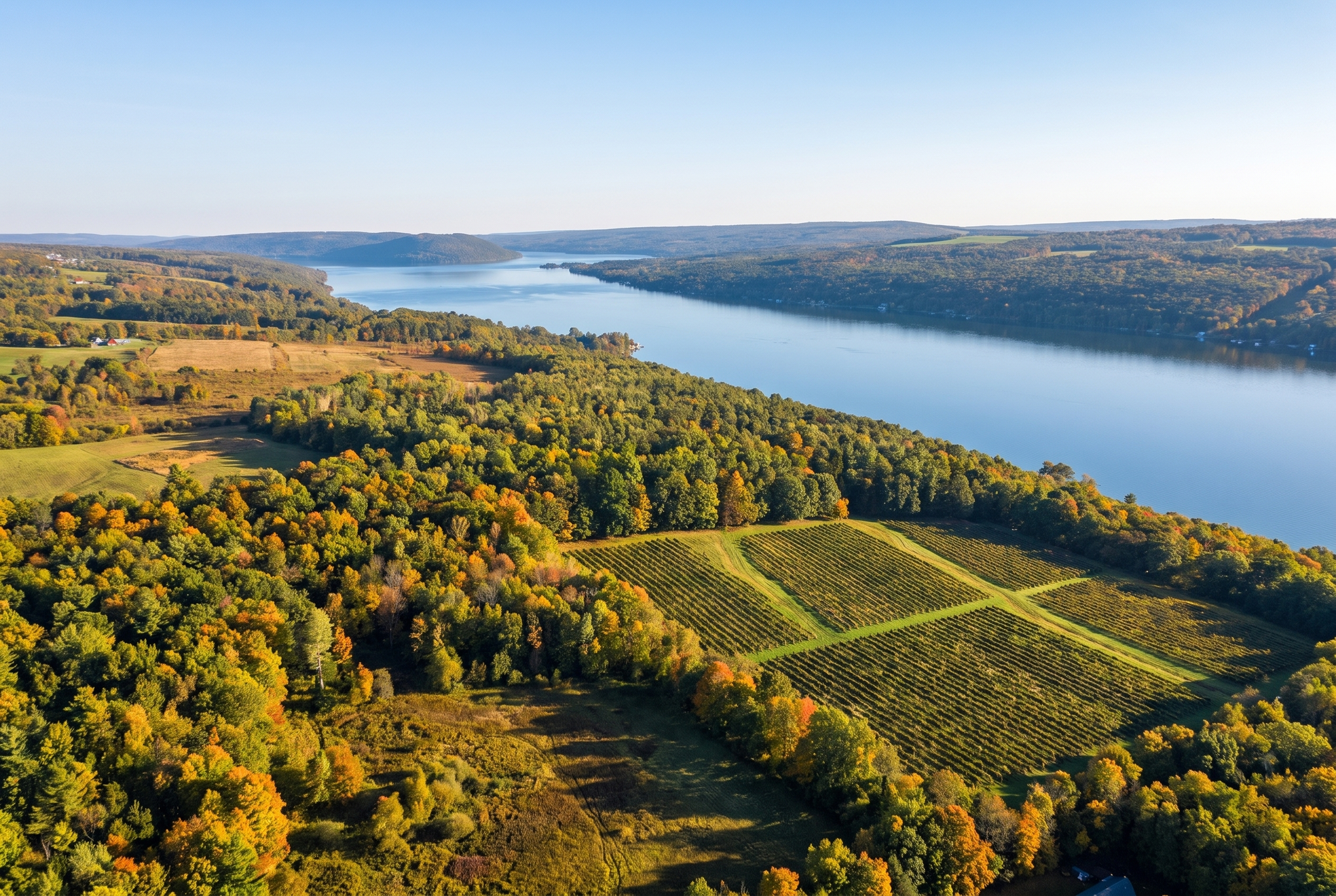
Glacial lakes act as giant radiators, keeping America’s best Riesling alive through brutal winters.
1. At a Glance
The Finger Lakes region of upstate New York wraps around eleven long, narrow lakes gouged out by Ice Age glaciers. Winters here should be too cold for fine wine, but the deep lakes store summer heat and release it all winter, sheltering the vineyards on their slopes. The payoff is Riesling with few equals in North America, plus fast-improving sparkling wine and Cabernet Franc, from more than 140 mostly small wineries (2024). Native and hybrid grapes still cover much of the acreage, a reminder that this region made wine for a century before European vines arrived.
Country: United States
Main grapes: Riesling, Cabernet Franc, Chardonnay, plus native and hybrid varieties such as Concord and Cayuga White
Signature styles: Dry to sweet Riesling; traditional-method sparkling wine; ice wine; light-bodied Cabernet Franc
Climate: Cool continental with cold winters, moderated by deep glacial lakes
Key appellations: Finger Lakes AVA, with nested Seneca Lake and Cayuga Lake AVAs
Vineyard area :About 10,790 producing acres (4,370 hectares) as of 2024
2. Why It Matters
This is the proof that the eastern United States can make wine of international standing. The Finger Lakes is America’s benchmark for Riesling, producing versions from bone dry to lusciously sweet that hold their own against Germany and Austria in blind tastings. It is also a living museum of American wine history, with commercial winemaking dating to the mid-1800s, decades before California’s rise. Prices have not yet caught up with quality, which makes this one of the smartest regions in the country for the curious drinker.
3. Land and Climate
The lakes are the whole story. Glaciers carved them so deep, 618 feet (188 meters) in Seneca Lake’s case, that they almost never freeze. All that water absorbs heat in summer and releases it in winter, keeping lakeside vineyards as much as 10 to 15°F (6 to 8°C) warmer than land only half a mile away. In spring the still-cold water delays bud break past the last frosts.
Vineyards therefore cling to the slopes above the shorelines, where cold air drains downhill instead of pooling among the vines. Soils are glacial leftovers, shale and gravel mixed with pockets of limestone, that drain well and force roots deep. The result in the glass is tension: modest alcohol, vivid acidity, and stony mineral flavors. Rain falls year-round, 30 to 40 inches (760 to 1,020 millimeters) annually, so growers fight fungus rather than drought.
4. Grapes and Styles
Riesling is the flagship, the most planted European variety here (2024), and the reason critics fly in from abroad. Dry versions snap with lime, green apple, and wet-stone minerality; semi-dry ones balance a touch of sweetness against electric acidity; and in the coldest years producers make ice wine, pressed from grapes frozen solid on the vine, intensely sweet yet fresh. The dry Rieslings deserve a place at the same table as Germany’s.
Reds are lighter here. Cabernet Franc is the best of them, fragrant with raspberry, herbs, and pepper, closer to France’s Loire Valley than to California. Chardonnay, Gewürztraminer, and Grüner Veltliner support a growing traditional-method sparkling wine scene, made the same way as Champagne. You will also see hybrids, crosses between European and cold-hardy American vines, such as Cayuga White, plus native Concord grapes destined mostly for juice. If you have only ever met sweet East Coast wine, the current generation of bone-dry Finger Lakes bottlings will be a genuine surprise.
5. Reading the Label
“Finger Lakes” on a label means at least 85 percent of the grapes grew within the AVA, the federally defined region; “Seneca Lake” or “Cayuga Lake” means 85 percent from those nested zones. A variety name guarantees 75 percent of that grape.
Sweetness is the thing to decode. Many producers print a dryness scale on the back label; otherwise, “Dry Riesling” means what it says, “Semi-Dry” or “Semi-Sweet” carries noticeable sugar, and “Ice Wine” is a dessert wine made from naturally frozen grapes. “Bottled by” versus “Produced by” also matters: only the latter guarantees the named winery actually fermented the wine.
6. A Short History
Grapevines went in at Hammondsport in 1829, and by 1900 the region had more than 50 wineries, mostly using native grapes. The turning point came in the 1950s, when Ukrainian immigrant Dr. Konstantin Frank insisted that European vines could survive the winters if grafted onto hardy rootstocks. He planted them in 1958, opened his winery in 1962, and was proven right within a few vintages. The Finger Lakes became an AVA in 1982.
Did You Know? Ice Age glaciers dug the Finger Lakes so deep that the bottoms of Seneca and Cayuga Lakes lie below sea level; Seneca reaches down 618 feet (188 meters). That mass of water almost never freezes, which is the only reason vineyards survive winters this far north.
8. At the Table
Dry Riesling is one of the most food-friendly wines on earth, and this region makes it in quantity. Pour it at 45 to 50°F (7 to 10°C) with the region’s lake fish, with pork, or with anything briny. Semi-dry Riesling is the house answer to spicy food; its light sweetness cools chili heat the way beer never quite does.
Cabernet Franc, served slightly cool at 55°F (13°C), suits roast poultry and mushroom dishes. Ice wine wants salty blue cheese or a fruit tart. Good dry Rieslings age beautifully for a decade or more, gaining honey and petrol notes; no decanting needed for anything here, though sweeter styles keep for weeks once opened.
Links
Producers’ association (Finger Lakes Wine Alliance): https://fingerlakeswinealliance.com
State wine institute (New York Wine & Grape Foundation): https://newyorkwines.org
Federal AVA regulator (TTB): https://www.ttb.gov/regulated-commodities/beverage-alcohol/wine/american-viticultural-area-ava