

The mountains here run the wrong way, and the wines are better for it.
1. At a Glance
Two hours north of Los Angeles, Santa Barbara County grows some of the coolest-climate wine in California, thanks to a geological fluke: its valleys open straight onto the Pacific. Chardonnay and Pinot Noir dominate the foggy west, while Rhône and Bordeaux grapes ripen a short drive inland. Around 200 wineries work the county’s seven appellations, most of them small, and many pour their wines in storefront tasting rooms in the towns of Los Olivos, Lompoc, and Santa Barbara itself rather than at grand estates.
Country: United States
Main grapes: Pinot Noir, Chardonnay, Syrah, Cabernet Sauvignon, Sauvignon Blanc
Signature styles: Taut, aromatic Pinot Noir and Chardonnay; cool-climate Syrah; Happy Canyon Bordeaux blends
Climate: Cool maritime in the west, warming steadily inland; morning fog and afternoon wind
Key appellations. Santa Maria Valley, Santa Ynez Valley, Sta. Rita Hills, Ballard Canyon, Happy Canyon, Los Olivos District, Alisos Canyon
Vineyard area: Roughly 21,000 acres (8,500 hectares) as of the mid-2020s
2. Why It Matters
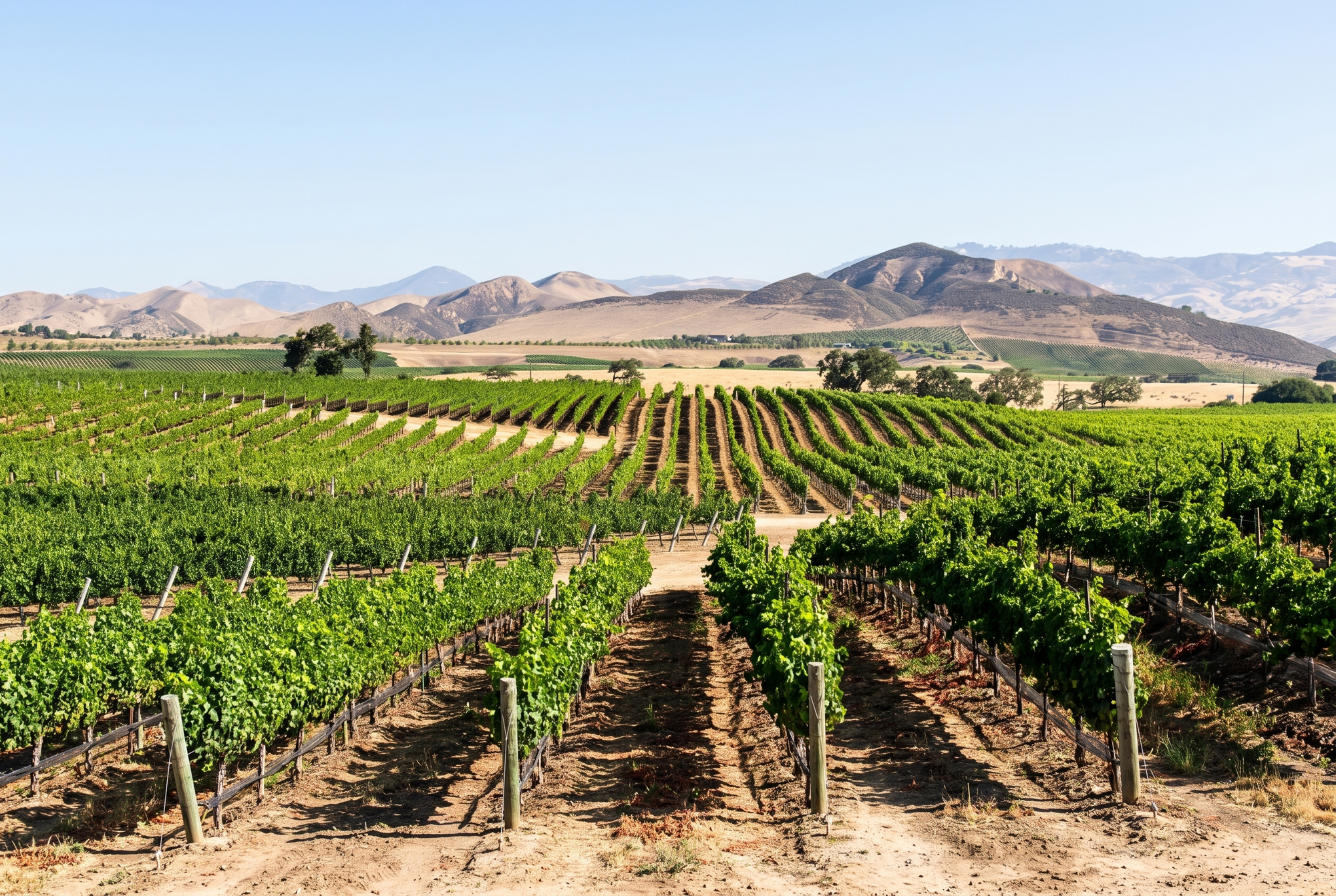
Almost every mountain range on the West Coast runs north to south, blocking the ocean. Santa Barbara’s run east to west, creating funnels that pull cold Pacific air and fog deep inland. The result is one of the longest growing seasons in California and Pinot Noir and Chardonnay with a tension most of the state cannot achieve. The 2004 film Sideways, shot here, turned the region into a household name almost overnight.
3. Land and Climate
Everything follows from the transverse valleys, the east-west corridors carved by the Santa Ynez and San Rafael ranges. The Pacific end of each valley is genuinely cold; average summer temperatures near Lompoc hover in the mid-60s°F (around 18°C), and grapes can hang on the vine well into October, building flavor slowly while keeping acidity.
Drive 30 miles (48 kilometers) east and the fog gives out. Happy Canyon, at the warm inland end of the Santa Ynez Valley, ripens Cabernet Sauvignon reliably. In between, each few miles adds a degree or two, which is why one small county supports seven distinct appellations.
Soils add another layer: sandy loams, marine shale, and pockets of diatomaceous earth, a chalky white soil made of fossilized algae that drains sharply and stresses vines into concentrated fruit. Rain is scarce, around 14 inches (360 millimeters) a year, so drought, not frost, is the grower’s main worry.
4. Grapes and Styles
The split is simple: cool-climate grapes near the ocean, warm-climate grapes inland. Pinot Noir led county plantings at about 36 percent in the mid-2020s, and the style is distinctive: darker-fruited and spicier than Oregon’s, with rose, black tea, and a saline edge in bottles from the Sta. Rita Hills. Chardonnay, about 28 percent of plantings, runs lean and citrusy with flinty minerality, far from the buttery California stereotype.
Syrah is the county’s stealth weapon, and it is underrated even by people who love the local Pinot. Cool-site versions from Ballard Canyon and the Sta. Rita Hills are peppery and meaty, in the mold of France’s northern Rhône. Warmer inland sites give Cabernet Sauvignon and Sauvignon Blanc in Happy Canyon, plus Grenache and a scatter of Italian and Spanish varieties. Rosé and traditional-method sparkling wine, made like Champagne, round out the picture. Across every style, the county signature is aromatic lift and acidity, wines that smell loud, taste vivid, and finish fresh.
5. Reading the Label
Any appellation name here means at least 85 percent of the grapes grew inside that AVA, the federally defined region. The names are your climate guide: “Sta. Rita Hills” and “Santa Maria Valley” signal cool-climate wines, “Happy Canyon” signals warmth, and the broad “Santa Ynez Valley” covers both extremes.
Note the odd spelling “Sta. Rita Hills”; it is deliberate, not a typo. Vineyard names such as Bien Nacido or Sanford & Benedict carry real weight locally and often justify their premium. A grape name guarantees 75 percent of that variety, and “Reserve” means nothing legally. When in doubt, buy by appellation and grape together, cool-zone Pinot or warm-zone Cabernet, and you will rarely be disappointed.
6. A Short History
Spanish missionaries planted grapes here in the late 1700s, but the modern industry dates to 1964, when the county’s first commercial vineyard went in near Santa Maria. Richard Sanford and Michael Benedict planted Pinot Noir in 1971 in what became the Sta. Rita Hills, proving the transverse valleys’ potential. Santa Maria Valley became one of California’s first AVAs in 1981, and Sideways supplied a tourism boom in 2004 that never fully receded.
Did You Know? The appellation is legally “Sta. Rita Hills”, abbreviation and all. Chile’s Viña Santa Rita winery objected that the original “Santa Rita Hills” name would confuse consumers, and in 2006, after negotiations, the American region agreed to shorten “Santa” to “Sta.” on every label.
7. At the Table
Santa Barbara Pinot Noir is a natural partner for the local catch, and the county eats well: grilled salmon, seared tuna, or duck breast, served with the wine at 55 to 60°F (13 to 16°C). The county’s lean Chardonnay is built for sea urchin, oysters, and lobster; chill it to 50°F (10°C) but no colder, or you will mute the aromatics you paid for.
Cool-climate Syrah pairs with lamb and anything involving black pepper or olives. Most wines here are ready on release; top Pinot and Syrah improve for 8 to 15 years, and decanting is optional rather than necessary. A picnic of local strawberries, tri-tip, and a chilled rosé is the county’s unofficial house pairing.
Links
Producers’ association (Santa Barbara Vintners): https://sbcountywines.com
Federal AVA regulator (TTB): https://www.ttb.gov/regulated-commodities/beverage-alcohol/wine/american-viticultural-area-ava