

A billion bottles rest in chalk cellars beneath these cool northern hills.
1. At a Glance
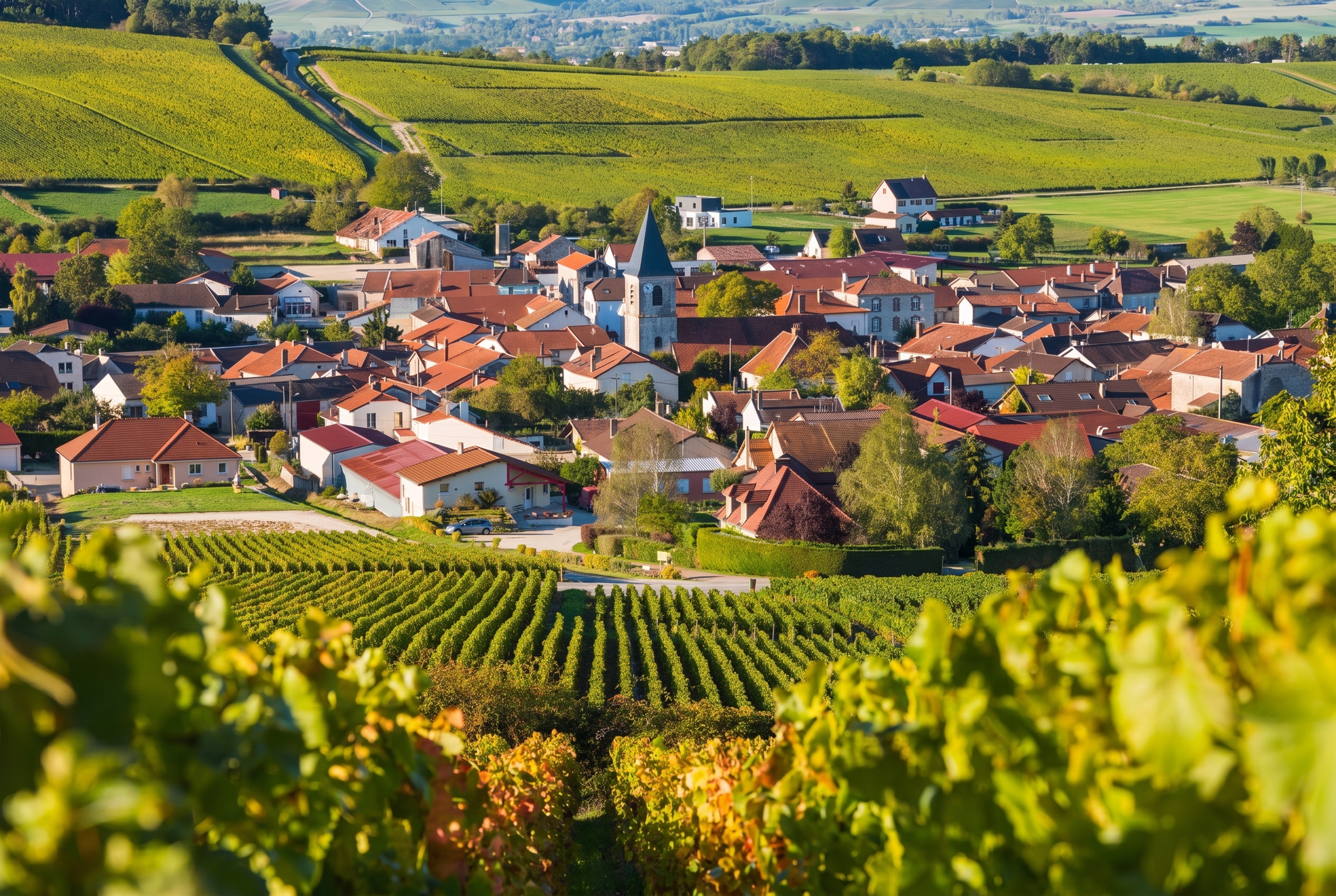
Champagne lies about 90 miles (145 kilometers) east of Paris, around Reims and Épernay, near the northern limit of where grapes ripen at all. That marginal climate is the point: it produces the high-acid base wine that becomes the world's benchmark sparkling wine. Only wine from this delimited region may legally carry the name, a rule its trade body defends in courtrooms worldwide.
Country: France
Main grapes: Pinot Noir, Meunier, Chardonnay
Signature styles: Traditional-method sparkling: non-vintage brut, vintage, rosé, blanc de blancs, blanc de noirs
Climate: Cool, at roughly 49 degrees north
Key areas: Montagne de Reims, Vallée de la Marne, Côte des Blancs, Côte des Bar
Vineyard area: About 84,000 acres (34,000 hectares) across 319 villages as of 2025
2. Why It Matters
Champagne wrote the template every serious sparkling wine follows: a second fermentation inside the bottle, long aging on yeast, and blending across years for consistency. It is also an economic machine, with about 16,200 growers and 360 houses shipping roughly 271 million bottles in 2024, and a legal one: 122 countries recognized protection of the Champagne name as of the mid-2020s.
3. Land and Climate
Everything rests on chalk. The porous subsoil drains rain yet stores moisture for dry spells, and it was soft enough to dig, which is why hundreds of kilometers of cellars run beneath Reims and Épernay at a constant cool temperature; some began as Gallo-Roman quarries called crayères. Wine can sleep down there for decades.
The cool climate at about 49 degrees north keeps acidity high, which sparkling wine needs, but it makes yields a gamble: frost, rain, and mildew regularly cut the crop, as in 2024, and the region adjusts its permitted yield every year in response, balancing harvest size against world demand; for 2025 the cap was set at 9,000 kilograms per hectare, the lowest in years. The slopes divide by grape: Pinot Noir on the Montagne de Reims, Chardonnay on the chalkiest slopes of the Côte des Blancs, frost-hardy Meunier in the Marne valley, and Pinot Noir again in the southerly Côte des Bar, an outpost that sits closer to Chablis than to Reims and supplies much of the region's base wine.
4. Grapes and Styles
Three grapes do almost all the work; four historical curiosities (Arbane, Petit Meslier, Pinot Blanc, Pinot Gris) are also permitted but cover well under 1 percent of the vines. Picking is by hand, by law, because whole clusters must be pressed gently, which is why the harvest mobilizes an army of roughly 120,000 seasonal workers each fall. The method matters as much as the fruit: a still, tart base wine is bottled with yeast and sugar; a second fermentation traps carbon dioxide; the wine then ages on its spent yeast (the lees), picking up bread and brioche flavors. Legal minimums are 15 months for non-vintage and 36 for vintage wines, and good producers go well beyond.
Non-vintage brut, blended across years to a house style, is the everyday standard. Vintage comes from a single, declared year. Blanc de blancs (Chardonnay only) is citrusy and chalky; blanc de noirs (dark grapes only) is fuller. Rosé here may be made by blending a little still red into white wine, something forbidden for other French rosés. Sweetness is set by the dosage, a small sugar addition made after the yeast is removed, and runs from brut nature (bone dry) through brut, the dominant style, to rarely seen demi-sec and doux.
5. Reading the Label
The dosage terms above are the first thing to check. The second is a two-letter code in tiny print: NM means a house that buys grapes; RM means a grower who farms and bottles their own, the "grower Champagne" category; CM is a cooperative. Grand cru and premier cru here rank entire villages, 17 of them at grand cru level, not individual vineyards.
Millésime means vintage. "Cuvée" on a Champagne label just means a particular blend or bottling, nothing more. A back-label disgorgement date, when the yeast sediment was removed, is a bonus sign of a transparent producer.
6. A Short History
Champagne made still wine for centuries, and bubbles were a fault until stronger English glass and cork stoppers made them manageable; the monk Dom Pérignon improved quality but did not invent sparkle. The 19th-century houses and famous widows, Clicquot above all, industrialized the process and conquered export markets. Fraud triggered vineyard riots in 1911, which led to strict boundaries, and the Comité Champagne has united growers and houses since 1941. The hillsides, houses, and cellars joined UNESCO's list in 2015.
Did You Know? More than one billion bottles are aging in Champagne's cellars at any given time, close to four years of worldwide shipments held in reserve (mid-2020s figures). The stockpile smooths out terrible harvests, of which this northern climate supplies plenty.
At the Table
Champagne is a food wine that rarely gets to prove it. Blanc de blancs with oysters or sushi is textbook. The acidity and bubbles are made for fried and salty things: fried chicken, potato chips, tempura, all genuinely work. Gougères and aged Comté flatter a mature vintage wine, and eggs, the classic wine-killer, actually get along with a creamy blanc de noirs at brunch. Rosé Champagne can carry duck or salmon through a main course.
Serve at 46 to 50°F (8 to 10°C). A flute looks festive, but an ordinary white-wine glass shows far more aroma. Non-vintage is ready when you buy it; vintage and prestige cuvées deepen for 10 to 20 years. Never decant it.
Links
Comité Champagne (regulatory body): https://www.champagne.fr/en/
Union des Maisons de Champagne (houses’ association): https://maisons-champagne.com/en/