

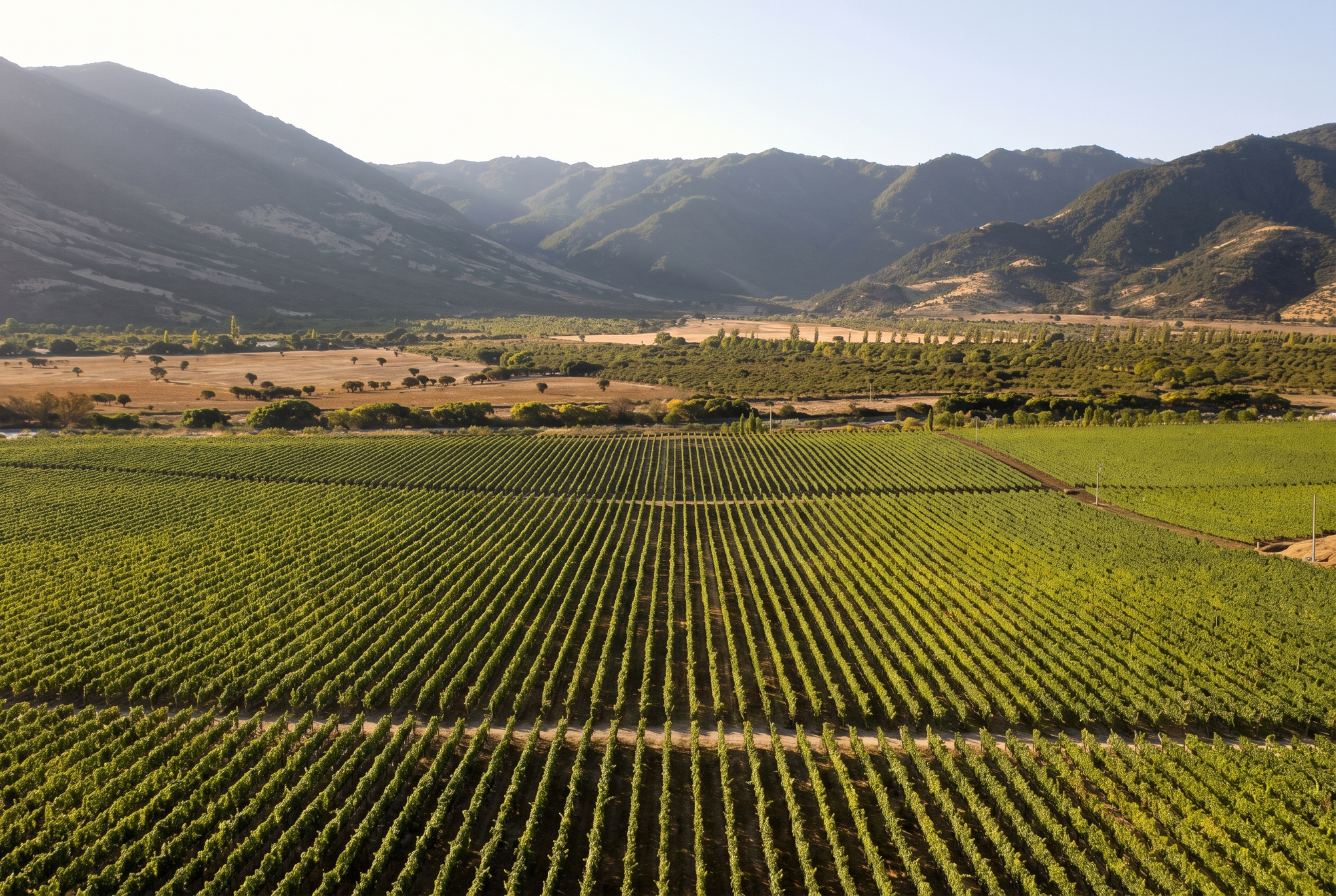
A horseshoe of hills called Apalta shelters some of South America's most expensive reds.
1. At a Glance
Colchagua spreads across the southern half of the Rapel Valley, about 80 miles (130 kilometers) south of Santiago. It is Chile's showcase red-wine region, the place that turned quiet farmland into polished estates, icon bottlings and the country's first wine route. Cabernet Sauvignon, Carmenère and Syrah lead the plantings.
Country: Chile
Main grapes: Cabernet Sauvignon, Carmenère, Merlot, Syrah, Malbec
Signature styles: Deeply colored, generous reds; plush single-vineyard Carmenère; emerging coastal whites
Climate: Mediterranean, cooled by Pacific breezes over low coastal hills
Key appellations: Colchagua Valley DO within Rapel; Apalta and Los Lingues (both DOs since 2018)
Vineyard area: About 36,000 hectares (89,000 acres) of wine grapes in the wider O'Higgins Region as of 2024 (SAG); Colchagua holds the larger share
2. Why It Matters
If Carmenère is Chile's calling card, Colchagua is where it earned the reputation. The valley supplies many of the country's most awarded reds, including cult wines from the Apalta hills that sell at triple-digit prices. It also pioneered Chilean wine tourism; local wineries organized the country's first wine route in 1996. For two decades, when the world pictured ambitious Chilean red wine, it usually pictured Colchagua.
3. Land and Climate
The valley runs roughly 70 miles (110 kilometers) from the Andes foothills to the Pacific. Its luck is topographic. The coastal hills here are unusually low, so cool ocean air pushes inland every afternoon, while cold air rolls off the Andes at night. The two effects stretch the ripening season. Grapes hang longer, build color and flavor, and still keep their acidity, which is why good Colchagua reds taste generous without turning heavy.
The most famous pocket is Apalta, a horseshoe-shaped amphitheater of hills opening south toward the Tinguiririca River. Its sheltered slopes hold warmth by day and drain cold air at night, a combination that suits late-ripening grapes. Near the ocean end of the valley, conditions turn genuinely cool, and recent plantings there behave more like white-wine country.
4. Grapes and Styles
Reds rule. Cabernet Sauvignon is the most planted grape by a wide margin, nearly 12,000 hectares (29,600 acres) in Wines of Chile's regional data published in 2023, and it makes ripe, dark-fruited wines with rounder tannins than Maipo's. Tannins are the grippy, drying compounds from grape skins; here they read as velvet rather than grain.
Carmenère is the signature. Grown on warm slopes and picked late, since it ripens weeks after Cabernet, it delivers black plum, chocolate and a savory edge of paprika and pepper. Harvest for it stretches deep into the southern fall, often two to three weeks after Cabernet comes in. Underripe versions taste of green bell pepper; the good ones are merely spicy. Syrah and Malbec add muscular alternatives, and most icon wines blend several of these grapes.
Coastal Colchagua is the plot twist. Sauvignon Blanc from the ocean end shows grapefruit, passion fruit and a saline snap. These coastal whites deserve far more attention than they get, though they remain a sliver of production.
5. Reading the Label
“DO” (Denominación de Origen, or denomination of origin) certifies geography only; there is no quality tier. “Colchagua Valley” means at least 75 percent of the grapes came from the valley, and the same 75 percent floor applies to a stated variety and vintage. Exporters usually hold to 85 percent for European markets. You may also see “Rapel Valley,” the broader zone that includes Colchagua and its neighbor Cachapoal; producers use it when they blend across both.
“Apalta” or “Los Lingues” marks one of Chile's first locality-level appellations, both created in 2018, and generally signals a top bottling. “Andes” or “Costa,” mentions added in 2011, tell you which end of the valley the fruit came from. “Reserva” and “Gran Reserva” promise slightly higher alcohol and, for the latter, oak aging. Nothing more. One quirk of southern-hemisphere labels: the vintage year is the harvest year, so a 2024 Colchagua red grew through the closing months of 2023.
6. A Short History
Colchagua was hacienda country for centuries: wheat, cattle and rustic wine for local tables. The transformation began in the late 1980s and 1990s, when ambitious Chilean families and foreign investors bet on the valley's slopes, planted noble varieties and built modern wineries. Export success followed fast. The 1996 launch of the country's first wine route rebuilt the local economy around visitors as much as bottles, and the 2018 recognition of Apalta and Los Lingues as standalone appellations confirmed what the market already believed about those hillsides.
Did You Know? When Chile finally created appellations smaller than a township, Colchagua claimed half of them. Of the four locality-level DOs approved in 2018, two are here: Apalta, the horseshoe of hills near Santa Cruz, and Los Lingues, on the Andes side. Both had sold wine at icon prices long before the law caught up.
7. At the Table
Carmenère and pastel de choclo, the Chilean corn-and-beef pie, is the region's happiest match; the wine's sweet spice echoes the dish's basil and caramelized corn. Cabernet and the big blends want grilled meats, and an asado of short ribs will flatter even modest bottles. Serve the reds at 60 to 64°F (16 to 18°C); Carmenère shows better a degree or two cooler, which tames its spice. Young icon reds from Apalta are dense and often oaky, so decant them for a full hour. Most will improve for 10 years or more. The coastal whites need only a hard chill, 45 to 50°F (7 to 10°C), and a plate of shellfish.
Links
Producers' association and wine route: Viñas de Colchagua — https://colchaguavalley.cl/ and https://rutadelvino.cl/en
Official industry body: Wines of Chile — https://www.winesofchile.org/
Official tourism board: Chile Travel, Wine Route — https://chile.travel/en/destinations/wine-route/