

The world's first formally demarcated wine region, drawn with granite markers in 1756.
1. At a Glance
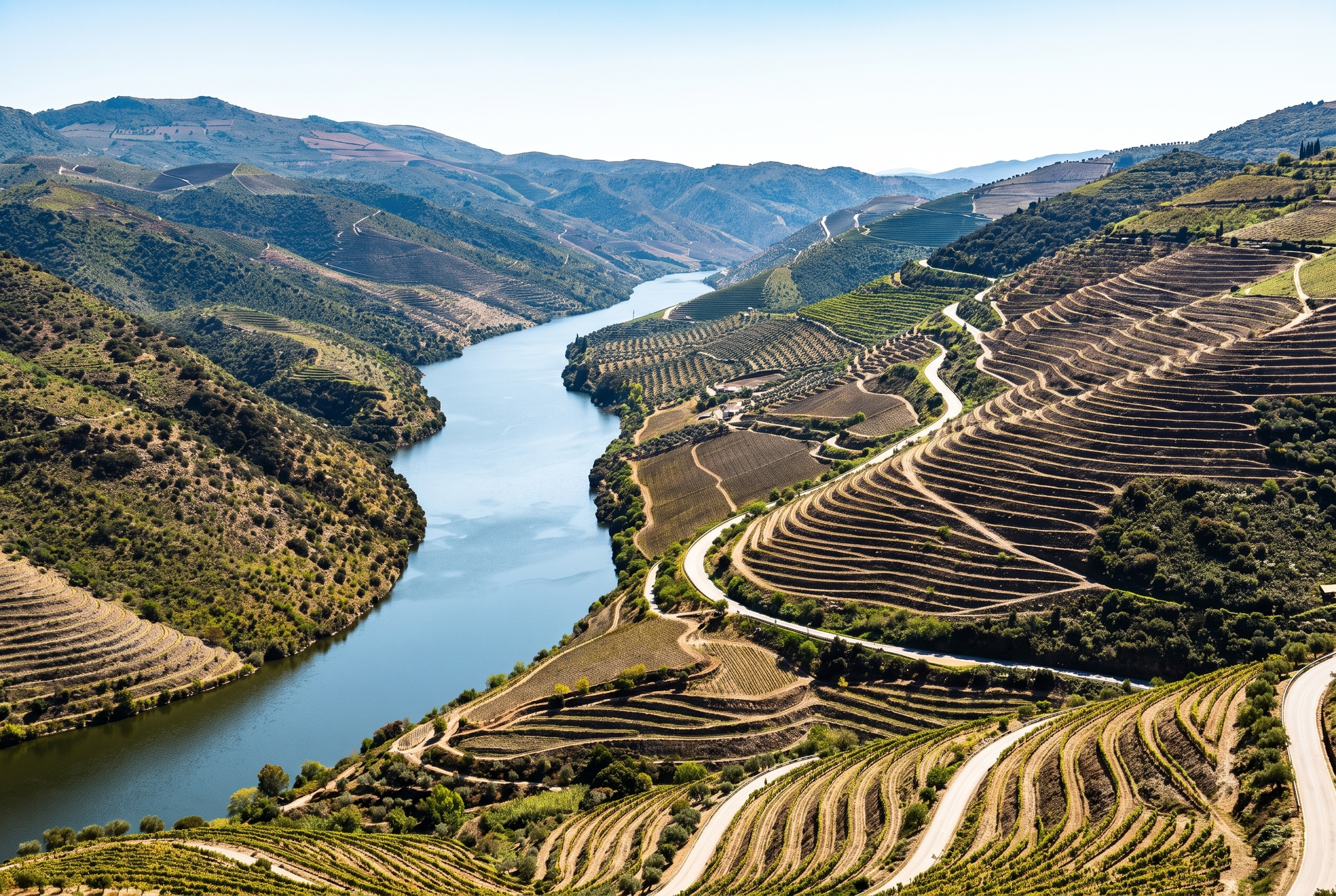
The Douro Valley in northeastern Portugal is a canyon system of terraced schist slopes carved by the Douro River and its tributaries. It is the birthplace of Port, the fortified wine that built the city of Porto's fortune, and, since the 1990s, the source of celebrated dry reds and whites from the same steep vineyards and the same native grapes. Dry wines now account for roughly half of the valley's output, and the terraced Alto Douro has been a UNESCO World Heritage Site since 2001.
Country: Portugal
Main grapes: Touriga Nacional, Touriga Franca, Tinta Roriz, Tinta Barroca, Tinto Cão (red); Viosinho, Rabigato, Gouveio (white)
Signature styles: Port in all its forms; concentrated dry reds; increasingly fine whites
Climate: Continental behind coastal mountains; hot, dry summers, cold winters
Key appellations: DOC Porto; DOC Douro; three subregions (Baixo Corgo, Cima Corgo, Douro Superior)
Vineyard area: A demarcated region of about 250,000 hectares (620,000 acres), of which under a fifth is planted (2020s)
2. Why It Matters
On September 10, 1756, the Marquis of Pombal drew a legal boundary around these vineyards to protect Port's authenticity, creating the world's first formally demarcated and regulated wine region, two centuries before France built its appellation system. Port remains the benchmark for fortified wine worldwide, and the valley's dry reds have joined Portugal's first rank within a single generation.
3. Land and Climate
The Marão and Montemuro mountains wall off the Atlantic, so while Porto on the coast is mild and rainy, the valley an hour inland bakes. Summers exceed 100°F (38°C); rainfall drops steadily as you travel east toward Spain.
The rock is the point. Vineyards grow on schist, a flaky, layered stone that splits vertically and lets roots tunnel yards deep for water; without it, dry farming on these slopes would be impossible. Gradients are so steep that generations of workers built stone-walled terraces by hand, and machines still cannot replace people at harvest. Since 1948, every vineyard parcel has been graded from A to F on soil, slope, altitude, and more, and the grade fixes how much Port each grower may make in a year. The three subregions run cooler and wetter in the west (Baixo Corgo, for lighter Ports) to hot and austere in the east (Douro Superior), with the Cima Corgo around Pinhão as the classic heart.
4. Grapes and Styles
More than a hundred grape varieties are authorized, but five red varieties lead the way: Touriga Nacional for structure and violet perfume, Touriga Franca (the most planted) for elegance, Tinta Roriz for body, plus Tinta Barroca and Tinto Cão. Old vineyards are often field blends, dozens of varieties interplanted in one plot, and many of the valley's most prized wines still come from those tangled old terraces.
Port is wine stopped mid-fermentation with clear grape spirit, which kills the yeast and leaves natural sweetness at 19 to 22 percent alcohol. Styles split into two families: bottle-matured (Ruby, Late Bottled Vintage, and Vintage Port, dark and fruit-driven) and wood-matured (Tawny, amber-colored, tasting of caramel, fig, and walnut from long barrel aging). White Port, made the same way from the valley's white grapes, runs from dry to sweet and is mostly drunk young as an aperitif.
Dry Douro DOC reds, recognized since 1979, are concentrated and firm, built from the same grapes. The dry whites, from old vines at altitude, deserve far more attention than they get.
5. Reading the Label
"Porto" or "Port" means fortified; "Douro" means dry table wine. On Port, the style word does the work: "Vintage" is a single great year, bottled young and meant to age for decades; "LBV" (Late Bottled Vintage) gives a taste of that style ready on release; "Tawny" with an age statement (10, 20, 30, 40 years) indicates the average age of the barrel-matured blend; "Colheita" is a tawny from a single year; "Reserva" is a step above basic Ruby or Tawny.
Every legitimate bottle of Port carries the IVDP's paper seal of guarantee across the capsule; it certifies the wine passed the institute's tasting panel and laboratory. On dry wines, "Douro DOC" plus a producer's name is the key information, and "Quinta" simply means a named estate.
6. A Short History
British merchants developed the Port trade in the 17th and 18th centuries, and fraud followed success. Pombal's 1756 demarcation, marked on the ground with 335 granite pillars, fixed boundaries and rules. For two centuries casks traveled downriver to Porto's cellars aboard flat-bottomed rabelo boats. Phylloxera devastated the valley in the late 1800s; recovery took decades. The 1952 debut of Barca Velha proved great dry red was possible here, and after Portugal joined the EU in 1986, independent estates turned that proof into a movement.
Did You Know? Many of the 335 granite boundary pillars planted in 1756, known as marcos pombalinos, still stand in the hills today. You can hike past 270-year-old legal documents carved in stone.
7. At the Table
Vintage Port with Stilton or another blue cheese is the textbook pairing; the salt and the sweetness trade punches. Decant Vintage Port always, both for sediment and for air, and finish the bottle within a few days. Serve aged Tawny lightly chilled at 54 to 57°F (12 to 14°C) with almond tarts, crème brûlée, or hard cheeses; an opened Tawny holds up for weeks. Chilled dry white Port makes an easy aperitif. Douro dry reds, at 61 to 64°F (16 to 18°C), stand up to roast lamb, game, and feijoada; young ones benefit from an hour of air, and the best age twenty years.
Links
Regulatory body (IVDP): https://www.ivdp.pt/en/
Official tourism board: https://www.visitportugal.com