

Dry Silvaner in a squat round bottle you can spot across the room.
At a Glance
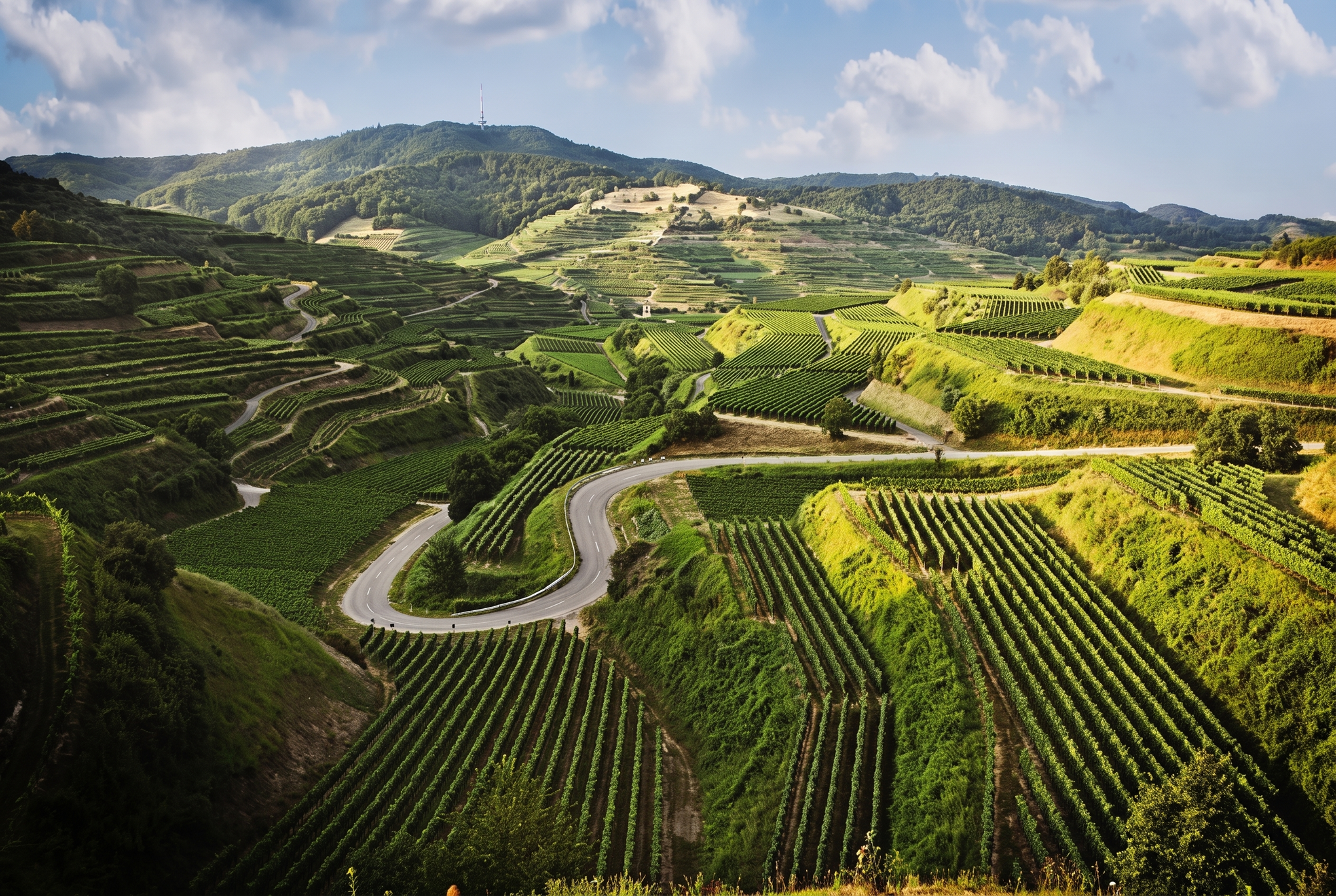
Franken follows the zigzags of the Main River through northern Bavaria, with Würzburg at its center. It is white-wine country with a personality unlike the Rhine regions: the grape is Silvaner more than Riesling, the taste is resolutely dry and earthy, and the round-bellied Bocksbeutel bottle is unmistakable.
Country: Germany
Main grapes: Silvaner, Müller-Thurgau, Bacchus, Riesling, Domina, Spätburgunder
Signature styles: Dry, savory Silvaner; aromatic Bacchus; sturdy reds from the sandstone west
Climate: Continental, with warm dry summers, cold winters, and real frost risk
Key appellations: One protected origin, Franken; Würzburg (the Stein site), Iphofen, Escherndorf, Randersacker; red-wine villages Bürgstadt and Klingenberg
Vineyard area About 15,200 acres (6,200 hectares) as of 2022
Why It Matters
Franken is Silvaner's world capital. The grape arrived in 1659 and found soils that turn its quiet character into something worth cellaring. The region also holds Würzburg's historic charitable estates, Bürgerspital, Juliusspital, and the Staatlicher Hofkeller, whose cellars have operated for centuries, and it kept faith with dry wine through the decades when Germany's export image was sugar. If you think German white means sweet, Franken is the rebuttal.
Land and Climate
The climate is continental: hot, dry summers, sharp winters, and spring frosts that can erase a crop. Growers cluster on south-facing bends of the Main, where the river tempers cold air, and they hedge with earlier-ripening varieties, which explains all that Müller-Thurgau.
Geology sorts the region into three parts, and the wines follow. Around Würzburg and the Maindreieck, the river's central triangle, Muschelkalk, a shell limestone laid down by an ancient sea, gives Silvaner and Riesling a chalky, saline spine. Eastward near Iphofen, gypsum-streaked Keuper marl produces broader, smokier whites. In the warmer west, the Mainviereck, red Buntsandstein sandstone suits Spätburgunder and the local Domina. Rain is scarce for Germany and sun plentiful, so the style everywhere is firm and dry, more about soil than fruit. When Franconians say a wine tastes of its ground, they mean it literally.
Grapes and Styles
Whites are 83 percent of plantings (2022). Silvaner (25 percent) is the flagship: pale, dry, medium-bodied, with pear, herbs, and hay over a mineral finish, less perfumed than Riesling and better behaved at the table. Simple versions are lunch wines; Grosses Gewächs bottlings from the Würzburger Stein or the Iphöfer Julius-Echter-Berg are dense and smoky and age for ten years or more. Silvaner is Germany's most food-friendly white, and nobody makes it better than Franken; that is this article's one editorial opinion, offered without apology.
Müller-Thurgau (23 percent) fills the everyday tier. Bacchus (12 percent), a local specialty, is loudly aromatic, all elderflower and grapefruit, best young and cold. Riesling is a minority act but excellent on limestone. Reds concentrate in the west: Domina, a Portugieser–Pinot Noir cross, gives dark, rustic wine, while Spätburgunder from the sandstone terraces of Bürgstadt and Klingenberg has quietly reached the national elite. Nearly everything, red or white, is fermented dry; fränkisch trocken, Franconian dry, is a cultural stance as much as a style.
Reading the Label
The national system applies: Qualitätswein is officially tested regional wine, Prädikatswein adds ripeness ranks from Kabinett up through Trockenbeerenauslese, trocken means dry and feinherb off-dry. In Franken you can usually skip the sweetness check, because dry is the default.
The bottle itself is information. The Bocksbeutel, the flattened round flask, is legally restricted to this region (with a few historical exceptions elsewhere), and producers reserve it for quality wine, so everyday bottlings appear in ordinary bottles. Site names follow the village-plus-vineyard pattern: Würzburger Stein is the Stein slope above Würzburg, Escherndorfer Lump the Lump above Escherndorf. Grosses Gewächs (GG) marks dry wines from top sites classified by the VDP producers' association, and labels from the Würzburg charitable estates carry centuries-old names worth trusting.
A Short History
Franken's vineyards peaked in the Middle Ages at many times today's size, supplying Bavaria and beyond. Würzburg's prince-bishops ran wine as statecraft, and the charitable foundations Bürgerspital (1316) and Juliusspital (1576) financed hospitals with wine, as they still do. Silvaner arrived in 1659 and slowly conquered the limestone. Frost, war, and phylloxera, a root-killing vine louse, shrank the region; postwar replanting favored hardy crossings like Müller-Thurgau and Bacchus, and the last three decades have swung the pendulum back to Silvaner and site.
Did You Know? The Bocksbeutel's shape has been protected under European Union law since 1989, reserved for quality wines from Franken and a few neighboring and historical enclaves, including part of northern Baden and scattered sites in Portugal. In 1726, Würzburg's Bürgerspital began filling its famous Stein wine into the flask to fight counterfeiting.
At the Table
Franconian food is hearty, and Silvaner was built for it: white asparagus in spring (the classic match across Germany), river fish, roast pork with dumplings, and the local Bratwürste. Bacchus suits salads and spicier cooking. Domina and Spätburgunder handle Schäufele, the crackling pork shoulder, and game from the Spessart forest.
Serve Silvaner at 48 to 52°F (9 to 11°C) and inexpensive Bacchus colder; reds do best at 57 to 61°F (14 to 16°C). Everyday bottles are for drinking now. GG Silvaner rewards patience and an hour of air, and a decade in the cellar turns it honeyed and smoky while the acidity holds the frame.
Links
Official regional wine bodies (Frankenwein-Frankenland GmbH / Fränkischer Weinbauverband): https://frankenwein-aktuell.de
Regional wine tourism board (Franken – Wein.Schöner.Land!): https://www.franken-weinland.de
National wine institute (Wines of Germany / DWI): https://www.winesofgermany.com