

Two thousand hectares, five grapes, and white wine aged under living yeast.
1. At a Glance
The Jura is a 50-mile (80-kilometer) strip of vines called the Revermont, tucked between Burgundy and the Swiss border in eastern France. With about 4,900 acres (2,000 hectares) as of 2024, it is one of the country's smallest wine regions, yet it holds outsized cult status. The reason is a family of wines made nowhere else the same way, crowned by the nutty, amber vin jaune.
Country: France
Main grapes: Chardonnay, Savagnin, Poulsard, Trousseau, Pinot Noir
Signature styles: Vin jaune, oxidative and fresh whites, pale reds, Crémant du Jura, vin de paille, Macvin
Climate: Continental, with cold winters and real frost risk
Key appellations: Arbois, Côtes du Jura, Château-Chalon, L'Étoile, Crémant du Jura, Macvin du Jura
Vineyard area: About 4,900 acres (2,000 hectares) as of 2024
2. Why It Matters
Vin jaune is one of the most distinctive wines on earth, and Jura is its only source. The region also holds a piece of history: Arbois received France's very first AOC (appellation d'origine contrôlée, the national system of place-based wine rules) in 1936. Louis Pasteur, born locally, did his pioneering fermentation research in Arbois, and a century later the region became a wellspring of the natural wine movement. Each winter the region throws the Percée du Vin Jaune, a festival built around piercing the first barrels of the new vin jaune release. Small region, long shadow.
3. Land and Climate
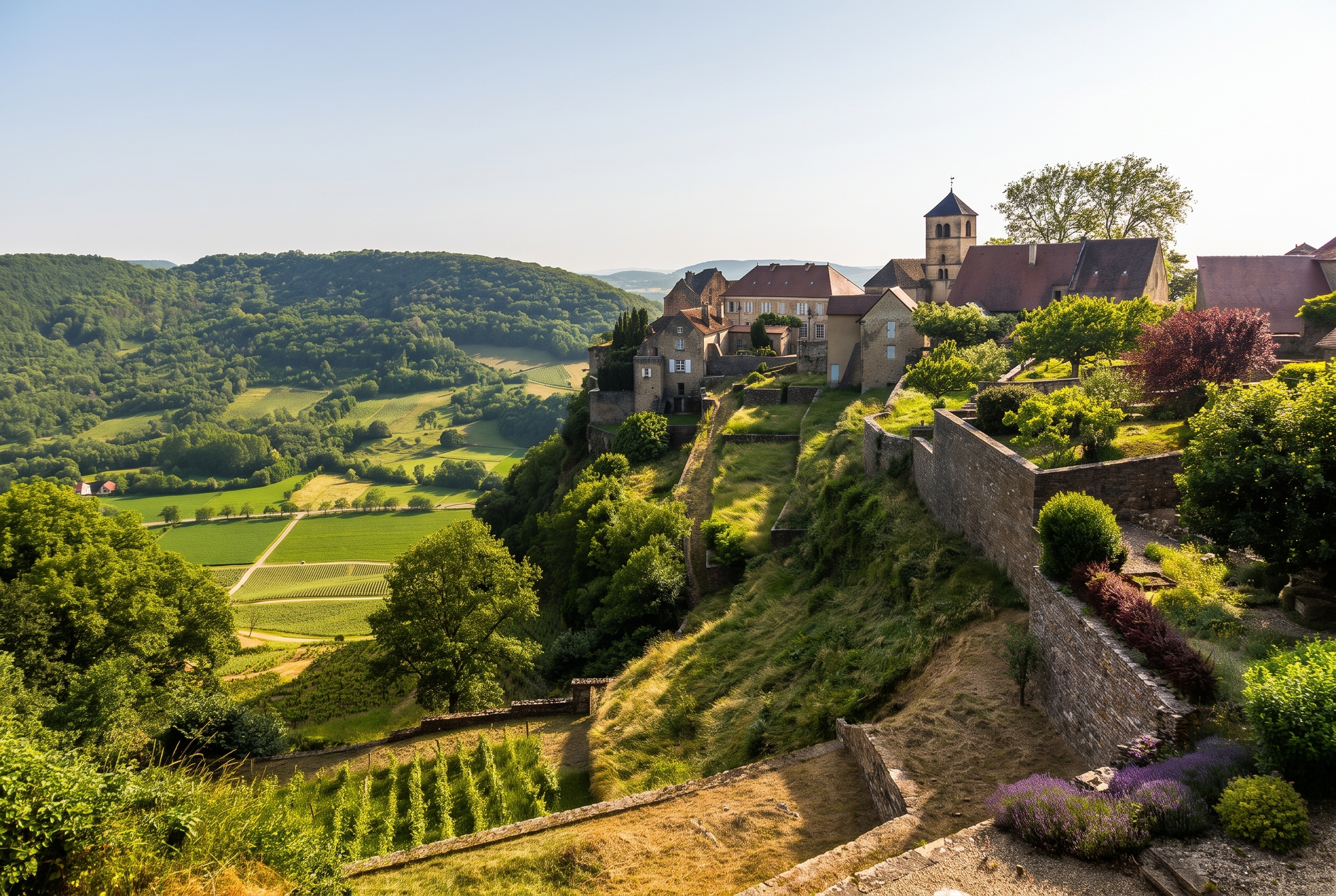
Vines grow on limestone and marl slopes at 820 to 1,300 feet (250 to 400 meters), facing west over the Bresse plain. Marl, a crumbly lime-rich clay, comes in gray and blue bands here; the blue marls around Château-Chalon are the classic ground for Savagnin, holding water and warmth for a grape that ripens dangerously late.
The continental climate is colder than Burgundy's, with harsh winters and frost that regularly bites; in 2024, frost, rain, and mildew destroyed well over half the crop in parts of the region. Growers often train vines high on the Guyot system, partly to lift the fruit away from frost pooling near the ground. The upside of the cold is acidity, the backbone that lets Jura whites and sparkling wines age so well. Expansion is limited for an unusual reason: much of the surrounding pasture belongs to farmers producing milk for Comté cheese, and they are not selling.
4. Grapes and Styles
Chardonnay covers roughly 40 to 45 percent of the vines (2020s figures), including a red-stemmed local strain called Melon à Queue Rouge, and comes in two schools. "Ouillé" wines are made in topped-up barrels and taste taut and alpine. "Sous voile" wines age in barrels left un-topped, where a film of native yeast, the voile, grows on the surface, shielding the wine while it slowly oxidizes into flavors of walnut, almond, and curry spice.
Savagnin is the signature grape and the sole source of vin jaune: aged sous voile for a legal minimum of six years and three months, bone dry and intense, with a near-immortal life in bottle. The reds are pale and fragrant: delicate Poulsard, deeper Trousseau, and increasingly good Pinot Noir. Crémant du Jura, the local bottle-fermented sparkler, may be the most underpriced traditional-method fizz in France. Vin de paille (straw wine) is a sweet rarity from grapes dried on racks or straw for at least six weeks before a winter pressing, and Macvin is grape juice fortified with local brandy.
5. Reading the Label
Arbois and Côtes du Jura are place appellations covering most styles; tiny L'Étoile allows whites only, including vin jaune and vin de paille. Château-Chalon is different: it produces vin jaune only, though the words "vin jaune" never appear on its labels. Crémant du Jura, Macvin du Jura, and vin de paille are product appellations.
The style clue to hunt for is "ouillé" (or the absence of oxidative words) for fresh wines, versus "tradition," "typé," or "sous voile" for the nutty school; when the label is silent, ask. Vin jaune always comes in the squat 62-centiliter clavelin bottle, so the shape itself is a label.
6. A Short History
Jura had about 49,400 acres (20,000 hectares) of vines before phylloxera, the root-eating louse, wrecked European vineyards in the late 19th century; it never recovered its size. Arbois growers organized early and won France's first AOC in 1936. The region then slid into obscurity until the 1980s and 1990s, when natural-wine pioneers such as Pierre Overnoy made its wines a global cult, followed by sommeliers everywhere.
Did You Know? Vin jaune must spend at least six years and three months in barrel under its yeast veil before release, and it is bottled only in the 62-centiliter clavelin. Open a bottle and it will not fade for weeks; well-cellared examples drink beautifully after 50 years.
7. At the Table
Vin jaune with a chunk of 24-month Comté is one of France's great pairings: the wine's walnut and spice mirror the cheese's crystals. The regional dish, poulet au vin jaune et aux morilles, chicken in a cream sauce of yellow wine and morel mushrooms, is worth the trip alone. Ouillé whites and Poulsard handle river fish and the local smoked charcuterie. Cooks here also pour vin jaune straight into the pan; a small glass transforms a cream sauce.
Serve vin jaune barely cool, around 60°F (15 to 16°C), and open it an hour or more ahead. Crémant and fresh whites want 46 to 50°F (8 to 10°C); Poulsard takes a light chill. Vin jaune and vin de paille age for decades; everything else drinks well within ten years.
Links
Comité Interprofessionnel des Vins du Jura (regulatory body): https://www.jura-vins.com/
Jura Tourisme (official tourism board): https://www.jura-tourism.com/