

The world's largest wine region quit the volume game.
1. At a Glance
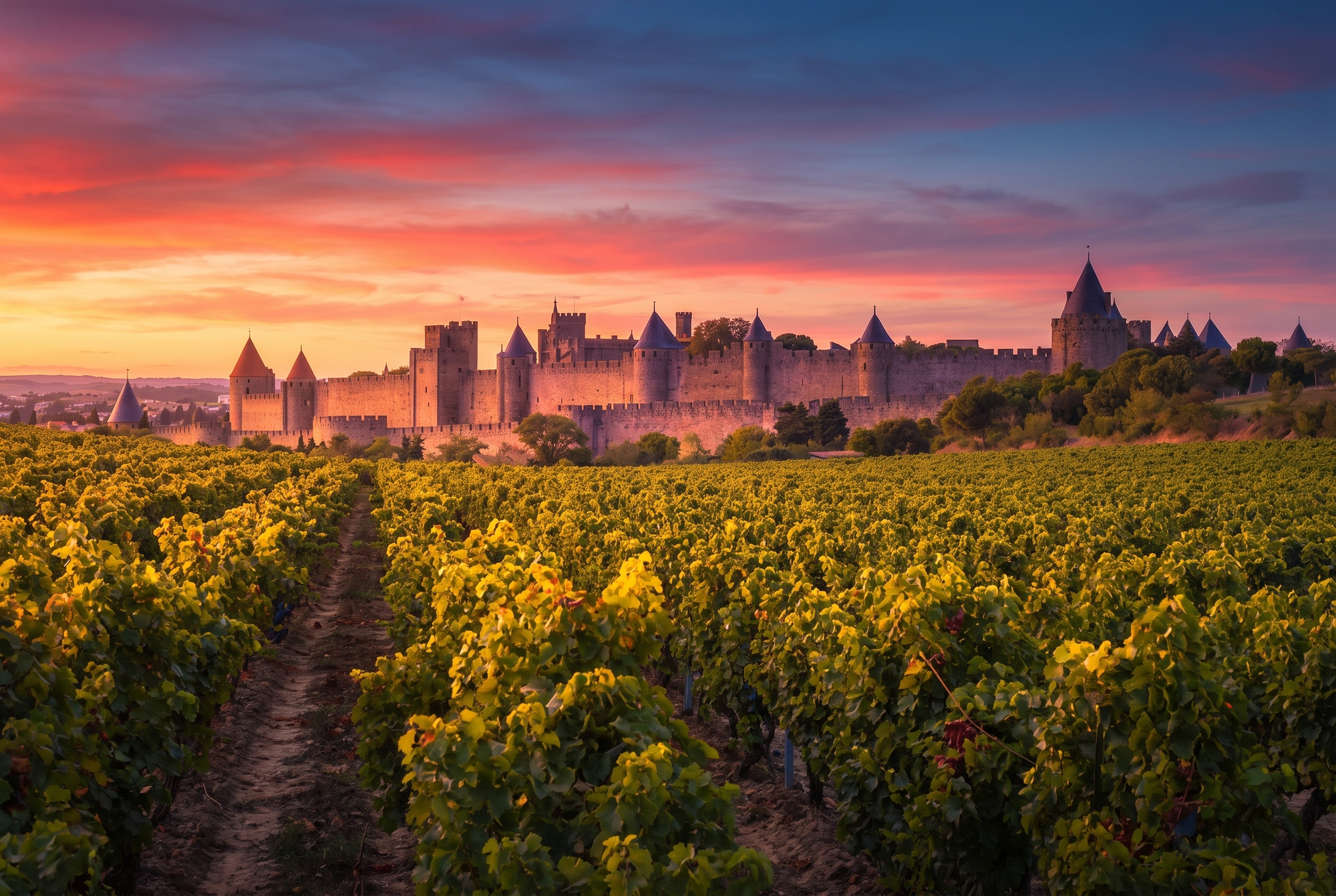
Languedoc-Roussillon arcs along France's Mediterranean coast from the Rhône delta to the Spanish border. With roughly 544,000 acres (220,000 hectares) as of 2024, it is the largest single wine region on the planet, producing about a third of French wine. It contains two personalities: the sprawling, fast-improving Languedoc, and Catalan-flavored Roussillon in the Pyrenean foothills, home of France's great fortified sweet wines.
Country: France
Main grapes: Grenache, Syrah, Mourvèdre, Carignan, Cinsault; Grenache Blanc, Piquepoul, and Muscat for whites
Signature styles: Hearty red blends, crisp whites, rosé, sparkling Limoux, fortified vins doux naturels
Climate: Mediterranean: hot, dry, windy
Key appellations: Languedoc, Corbières, Minervois, Faugères, Saint-Chinian, Pic Saint-Loup, Fitou, Limoux; Côtes du Roussillon, Banyuls, Maury; IGP Pays d’Oc
Vineyard area: About 544,000 acres (220,000 hectares) as of 2024
2. Why It Matters
One French bottle in three starts here, and the IGP Pays d'Oc category, itself covering some 120,000 hectares (2020s figures), made this the engine of affordable varietal wine in France. The region also leads the country in organic farming and, because vineyard land costs a fraction of Burgundy or Bordeaux prices, it has become the arrival hall for ambitious young winemakers. The story of the past 40 years is a deliberate trade: less wine, better wine.
3. Land and Climate
The region is an amphitheater facing the sea, stretching about 150 miles (240 kilometers) from the Pyrenees to the edge of Provence, with more than 2,500 hours of annual sunshine. Two dry winds, the tramontane and the mistral, blow hard and often; they strip humidity off the vines, which slashes disease pressure and is the practical reason organic farming spread so widely here. The genuine threat is drought, and appellation rules still restrict irrigation in many zones.
Quality follows altitude and poor soil. The coastal plain's fertile alluvium built the old bulk-wine economy. The serious wines come from the hills: schist in Faugères and on Banyuls's steep terraces, limestone in the garrigue scrubland below Pic Saint-Loup, high cool sites in Terrasses du Larzac. Same region, different planets.
4. Grapes and Styles
Reds dominate. The core blend is Grenache, Syrah, Mourvèdre, and Cinsault, plus Carignan, an old workhorse whose surviving ancient vines now produce some of the region's most characterful wine. Fitou, the region's first red appellation (1948), shows the style at its most traditional. Expect dark berries, black olive, and an herbal note growers compare to the surrounding garrigue of thyme and rosemary.
Whites are the most exciting development here, and I would argue they now outshine many of the reds: lemony Picpoul de Pinet from the oyster lagoons, and increasingly serious blends of Grenache Blanc, Roussanne, and Vermentino from altitude. Limoux makes sparkling wine three ways, including the ancestral single-fermentation method; locals claim the monks of nearby Saint-Hilaire documented sparkling wine in 1531, more than a century before Champagne's rise. Sweet Muscats from Frontignan and Saint-Jean-de-Minervois round out the range. Roussillon's specialty is vins doux naturels, wines whose fermentation is stopped with grape spirit to keep natural sweetness: Muscat de Rivesaltes, Maury, and Banyuls, France's answer to port.
5. Reading the Label
Three tiers to know. AOC (or AOP) wines follow strict place-based rules and are usually blends: Corbières, Minervois, Faugères, and the rest. IGP wines (indication géographique protégée) follow looser rules over bigger areas; IGP Pays d'Oc is the giant of the category and the place to find varietal-labeled Chardonnay, Sauvignon, Merlot, or Viognier. Vin de France sits below both, a catch-all with maximum freedom and minimum guarantees.
Inside the Languedoc AOC family, a cru layer marks the best-defined zones, with stricter yields and aging: Minervois-La Livinière, Corbières-Boutenac, La Clape, Pic Saint-Loup. The crus amount to only about 5 percent of the region's appellation production (2020s figures), which keeps their prices honest. On Roussillon reds, "Villages" signals the better hill fruit. "Vieilles vignes" (old vines) is legally undefined but often meaningful here, given the stock of century-old Carignan.
6. A Short History
Greeks planted vines near the coast around the fifth century BC, making this one of France's oldest vineyards. The 19th-century railway turned it into a factory for cheap red to supply industrial workers, and collapse followed: the great winegrowers' revolt of 1907 brought hundreds of thousands into the streets and troops into the towns before the government backed down with France's first fraud-control laws. From the 1980s the region pulled up plains vineyards, replanted hillsides with better grapes, and rebuilt itself around appellations, capped by the umbrella Languedoc AOC in 2007.
Did You Know? More than a third of France's organic wine is grown in Languedoc-Roussillon (2020s figures), making it the country's organic leader by a wide margin. The credit belongs partly to the wind: constant dry tramontane and mistral keep vineyard fungus at bay with little spraying.
7. At the Table
Cassoulet, the slow white-bean and duck stew of the western Languedoc, meets its match in a sturdy Corbières or Minervois; the tannin cuts the fat. Grilled lamb with herbs suits Pic Saint-Loup or Faugères, and brandade de morue, the salt-cod purée of Nîmes, works with a white or a rosé. Oysters from the Bouzigues beds want Picpoul de Pinet, grown beside the same lagoon. And Banyuls with dark chocolate is one of the few genuinely great wine-and-chocolate matches.
Serve the reds around 61°F (16°C) and Picpoul properly cold at 46°F (8°C). Most bottles are built for drinking within five years; the crus, Banyuls, and Maury reward a decade or more.
Links
Conseil Interprofessionnel des Vins du Languedoc (regulatory body): https://languedoc-wines.com/en/
Conseil Interprofessionnel des Vins du Roussillon (regulatory body): https://www.roussillon.wine/