

A 1965 research paper turned remote dairy country into Cabernet's Australian home.
1. At a Glance
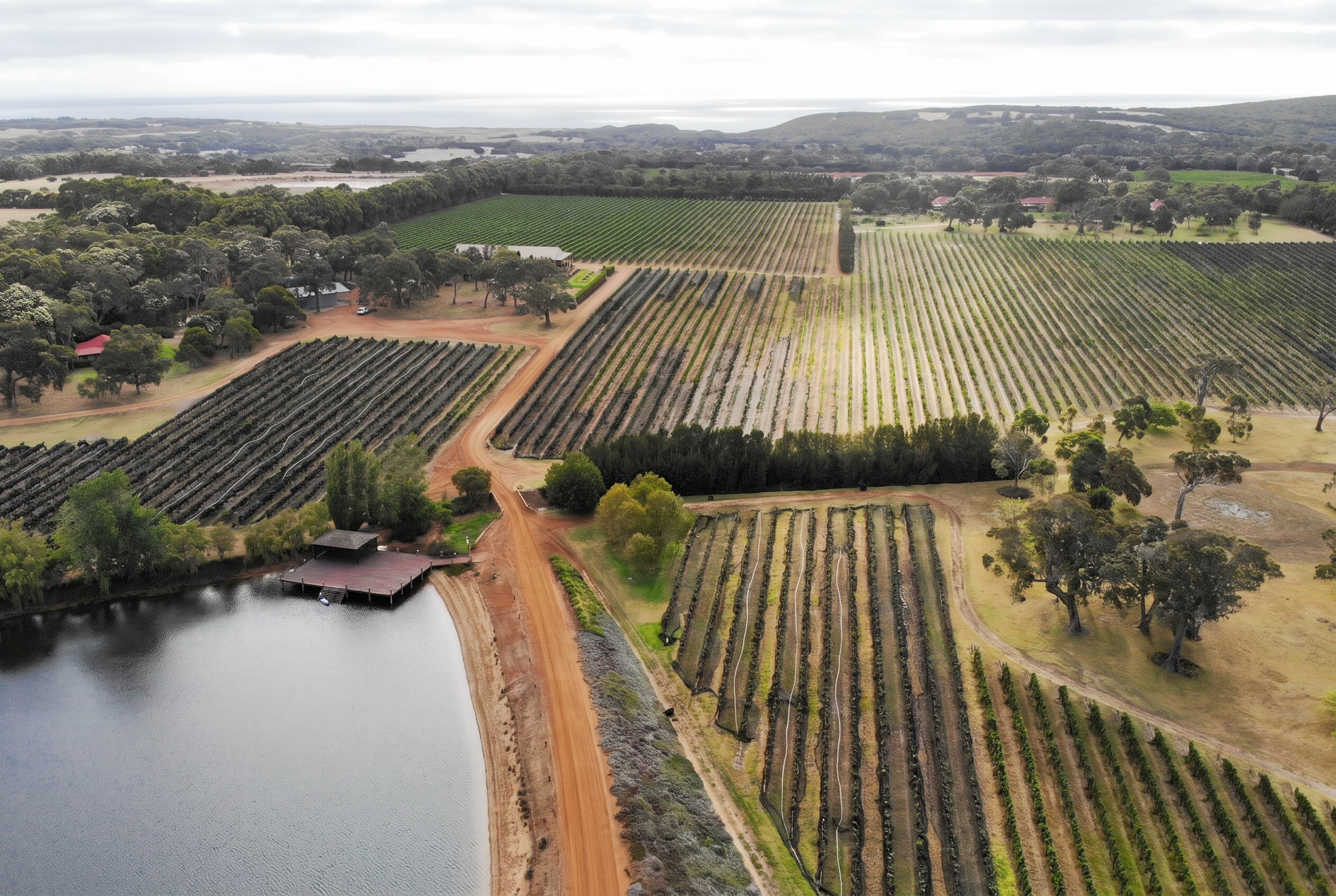
Margaret River occupies a peninsula in Western Australia's far southwest corner, about 170 miles (280 kilometers) south of Perth, with ocean on three sides. It is a young region, first planted commercially in 1967, yet its Cabernet Sauvignon and Chardonnay now rank with Australia's finest, and its wines command premium prices far out of proportion to the region's size. Around 200 producers, most of them family-owned, farm a strip of forest and pasture country between two ocean capes.
Country: Australia
Main grapes: Cabernet Sauvignon, Chardonnay, Sauvignon Blanc, Semillon, Shiraz
Signature styles: Structured Cabernet; refined Chardonnay; Semillon-Sauvignon Blanc blends
Climate: Mediterranean with strong maritime influence
Key appellations: Margaret River GI (no official subregions)
Vineyard area: About 14,150 acres (5,725 hectares), 2020 national vineyard scan
2. Why It Matters
Margaret River proved that Australia could make restrained, age-worthy wine in the European mold, from one of the most geographically isolated wine regions on earth. The region crushes only around 2 to 3 percent of the nation's grapes yet supplies over a fifth of its premium-priced wine, according to the regional association. Its Cabernets draw constant comparison with Bordeaux, and its Chardonnays compete with the world's best.
3. Land and Climate
The region runs about 60 miles (100 kilometers) between two capes, Naturaliste and Leeuwin, jutting into the Indian Ocean. That geography is the whole story, and it explains why Wine Australia calls this one of the most strongly maritime climates in Australian wine. The surrounding water moderates everything: summers stay warm rather than hot, winters are mild, and frost is rare. Grapes ripen slowly and evenly, keeping fresh acidity alongside full flavor, which is why the wines taste ripe yet restrained.
Rain is generous, around 40 inches (about 1,100 millimeters) a year, but it falls mostly in winter, leaving the growing season dry and disease pressure low. Vintage variation is smaller here than in almost any other Australian region, a genuine commercial advantage. The prized soils are ancient, free-draining gravelly loams over granite, locally associated with red gum forest country. Poor soils mean modest yields and small, thick-skinned berries, which translate into concentration and fine tannin in the reds.
4. Grapes and Styles
Cabernet Sauvignon is the flagship red. Expect a medium- to full-bodied wine with blackcurrant, cedar, and bay leaf, fine powdery tannin, and the structure to age 15 years or more. Many top bottlings use the Houghton clone, a heritage vine selection unique to Western Australia. Cabernet is often blended with Merlot or Malbec in the Bordeaux manner.
Chardonnay is the flagship white, and arguably now the region's greater achievement: intense citrus and stone fruit, firm acidity, and careful French oak, in a style that ages 8 to 12 years. Leeuwin Estate's Art Series set the standard, and a Decanter award naming its 1981 vintage the world's best Chardonnay announced the region internationally.
The everyday specialty is the SSB or SBS, a crisp, grassy blend of Sauvignon Blanc and Semillon that shows the blend's proportions in its initials; it is inexpensive, refreshing, and one of Australia's most reliable warm-weather whites. Shiraz here is medium-bodied and peppery rather than heavy, and small plantings of Chenin Blanc, Malbec, and Mediterranean varieties round things out.
5. Reading the Label
"Margaret River" is a Geographical Indication, or GI, a legally protected regional name under Australian law; using it requires at least 85 percent of the fruit to come from within the boundary, which was registered in 1996. The same 85 percent rule applies to any grape variety or vintage stated on the label.
There are no official subregions, but you may see district names such as Wilyabrup, Wallcliffe, or Karridale on labels or back labels; these are informal and unregulated, though Wilyabrup in particular has a strong reputation for Cabernet. "SSB" and "SBS" indicate Semillon-Sauvignon Blanc blends, with the dominant grape listed first, as Australian law requires blend components to appear in descending order.
6. A Short History
Vines came late here. In 1955, visiting University of California professor Harold Olmo flagged Western Australia's southwest for fine wine, and in 1965 and 1966 local agronomist Dr. John Gladstones published papers matching Margaret River's climate and soils to premium viticulture, drawing parallels with Bordeaux. Perth cardiologist Dr. Tom Cullity acted first, planting Vasse Felix in 1967; Moss Wood, Cape Mentelle, Cullen, and Leeuwin Estate followed within a decade. International trophies in the 1980s sealed the region's rise.
Did You Know? Margaret River exists because of homework, not heritage. Agronomist John Gladstones' 1965 and 1966 papers predicted, from climate and soil data alone, that this remote dairy and timber district could rival Bordeaux; doctors and farmers who read them planted the region's founding vineyards within a few years.
7. At the Table
Margaret River Cabernet is a natural partner for grilled or roasted lamb and beef; its fine tannins also suit hard cheeses. Decant young bottles for an hour, serve at about 61 to 64 degrees Fahrenheit (16 to 18 Celsius), and don't hesitate to cellar good vintages for a decade. Chardonnay shines with the local marron (a freshwater crayfish), lobster, roast chicken, and cream sauces; serve it lightly chilled, around 50 to 54 degrees Fahrenheit (10 to 12 Celsius), not ice cold. The zesty SSB blends are built for raw oysters, grilled fish, and warm-weather drinking within a couple of years of release, served as cold as you like. As a rule of thumb, drink the region's whites young and its Cabernets old.
Links
Official producers' association (Margaret River Wine Association): https://margaretriver.wine/
Wine Australia regional profile: https://www.wineaustralia.com/market-insights/regions-and-varieties/western-australia-wines/margaret-river