

From sheep paddocks to seventy-five thousand acres of vines in barely fifty years.
At a Glance
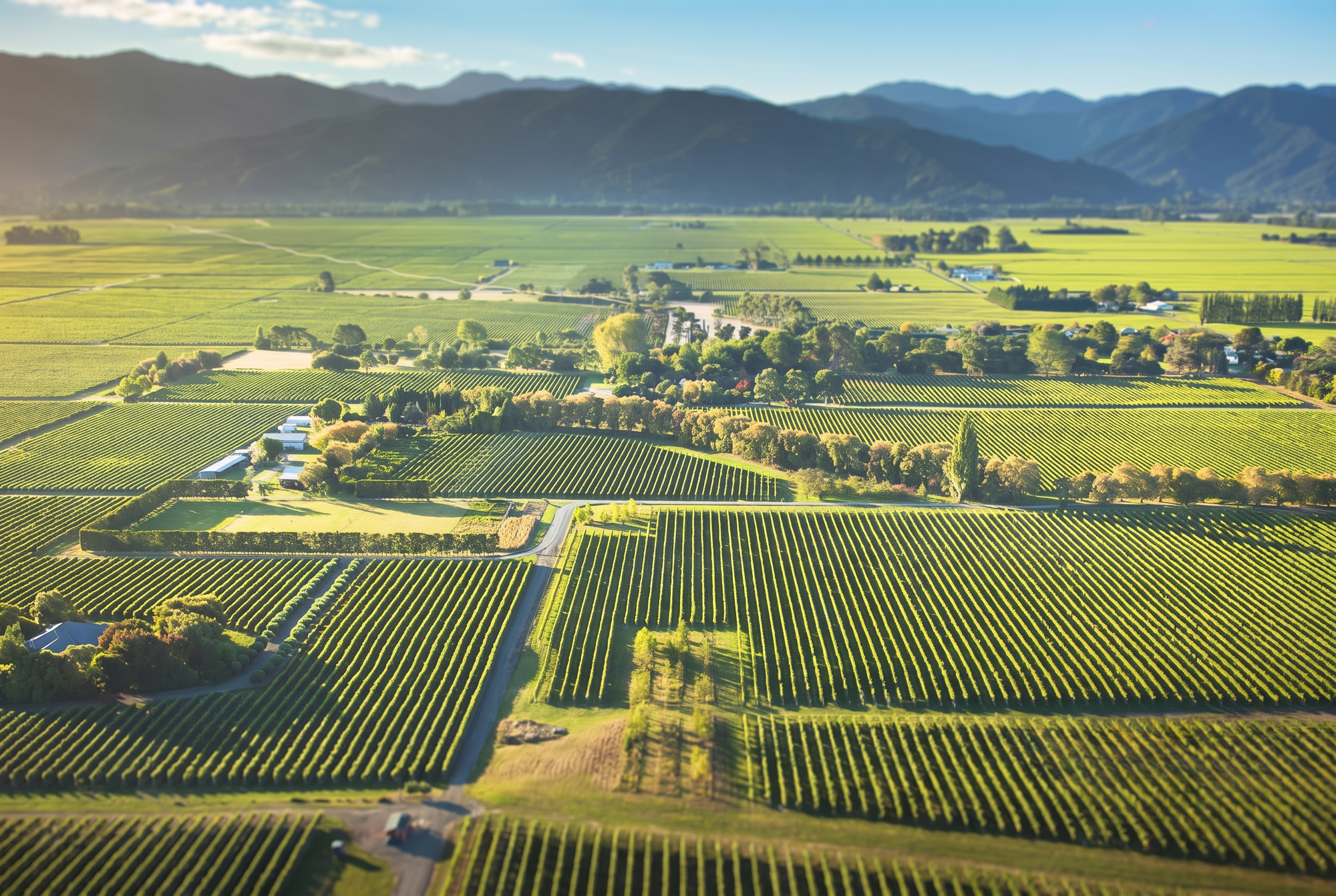
Marlborough fills the dry, sunny northeastern corner of New Zealand's South Island, around the town of Blenheim. It is the engine room of the national industry, holding nearly three-quarters of the country's vines on the valley floors of the Wairau and Awatere rivers. Its Sauvignon Blanc created a style the rest of the world now imitates. Blenheim, the hub town, is ringed by vines in every direction, and the scale still surprises first-time visitors: one flat valley planted nearly wall to wall.
Country: New Zealand
Main grapes: Sauvignon Blanc, Pinot Noir, Pinot Gris, Chardonnay
Signature styles: Pungent dry Sauvignon Blanc; Pinot Noir; traditional-method sparkling wine
Climate: Dry, sunny maritime with cool nights
Key appellations: Marlborough GI, with the Wairau Valley, Southern Valleys, and Awatere Valley sub-regions
Vineyard area: About 75,200 acres (30,444 hectares) in 2024
Why It Matters
Marlborough put New Zealand on the world wine map. When Cloudy Bay's 1985 Sauvignon Blanc reached export markets, critics treated it as a new category: a white wine of startling aroma and freshness. The region now holds 72 percent of New Zealand's vineyard area (2024), and most of the country's wine is made from its grapes. For millions of drinkers, Marlborough Sauvignon Blanc simply is New Zealand wine. Growth has not stopped, either: the region added about 1,170 acres (474 hectares) of producing vines between 2023 and 2024, more than Auckland's entire vineyard.
Land and Climate
Two ranges do the heavy lifting. The Richmond Range blocks wet weather from the north and west, and the Wither Hills shelter the south. What remains is one of New Zealand's sunniest, driest climates. Long, cool ripening days build flavor slowly while cold nights lock in acidity. That day-night swing is why the wines taste so vivid.
Soils divide the region into three sub-regions, meaning distinct zones within the larger area. The Wairau Valley floor is old riverbed: deep, free-draining gravel that gives ripe, tropical-leaning Sauvignon Blanc. The Southern Valleys carry more clay, which holds water and suits Pinot Noir. The Awatere Valley is higher, cooler, and windier, and its wines lean herbal and mineral. Most big brands blend fruit from all three; single-sub-region bottlings show you the contrasts clearly. Rainfall is low by national standards, so many vineyards irrigate from the rivers and the aquifer beneath the valley.
Grapes and Styles
Whites. Sauvignon Blanc is the region. It covered about 62,200 acres (25,157 hectares) in 2024, more than four-fifths of all plantings. The classic style is unmistakable: passion fruit, gooseberry, cut grass, and a bone-dry, mouthwatering finish, fermented in steel tanks and sold young. A smaller school ferments in old oak barrels and leaves the wine on its lees, the spent yeast that adds a creamy texture. These barrel-fermented Sauvignons deserve far more attention than they get. Pinot Gris comes next, usually soft and pear-scented; Chardonnay and Riesling run from crisp and dry to lightly sweet, and Gewurztraminer persists in small plots for growers who value its perfume. Awatere Sauvignon tastes noticeably greener and saltier than Wairau Sauvignon, and buying one bottle of each makes the contrast easy to test at home.
Reds. Pinot Noir, at about 6,150 acres (2,490 hectares) in 2024, is the main red: fragrant, cherry-fruited, gently structured, and best within eight years of the vintage.
Sparkling and pink. Traditional-method sparkling wine, made by refermenting the wine inside its bottle as in Champagne, has a history here dating to the 1970s. Pinot Noir rose is the region's fastest-moving newcomer.
Reading the Label
'Marlborough' on a bottle is a Geographical Indication, or GI: a legally protected place name. Unlike a French appellation, a New Zealand GI controls only where the grapes grew, never the grape variety, yield, or winemaking method. The number to remember is 85. If a label names a region, a variety, or a vintage, at least 85 percent of the wine must match each claim.
Sub-region names such as Awatere Valley signal a more specific origin. An 'Appellation Marlborough Wine' seal is a voluntary certification requiring 100 percent Marlborough fruit and bottling in New Zealand. The Sustainable Winegrowing NZ logo certifies vineyard practices; it does not mean organic. 'Single vineyard' and 'reserve' carry no legal definition. Back labels often carry more useful detail than fronts, including sub-region and vineyard names.
A Short History
Commercial wine here began on August 24, 1973, when Montana Wines planted the region's first large-scale vineyard on former sheep country. Sauvignon Blanc followed in 1975, essentially as an experiment. Cloudy Bay's 1985 debut turned that experiment into an international phenomenon, and plantings have expanded almost without pause since. The Marlborough GI was registered in 2018.
Did you know? One grape in one region now accounts for most of an entire country's vines. Marlborough Sauvignon Blanc alone covered about 62,200 acres (25,157 hectares) in 2024: roughly 59 percent of all vineyard land in New Zealand.
At the Table
Sauvignon Blanc's acidity was made for the local seafood. Green-lipped mussels, oysters, and whitebait fritters are the classic partners. Goat cheese and asparagus, two foods that fight most wines, work beautifully here. Serve it cold, 45 to 50 F (7 to 10 C), drink most bottles within three years, and skip the decanter. Pinot Noir suits duck, salmon, and lamb; pour it lightly chilled, around 57 F (14 C). Barrel-fermented Sauvignon and the better Chardonnays reward five to ten years of patience. When Sauvignon Blanc's intensity would shout over a delicate dish, a dry Riesling or Pinot Gris covers the middle of the table instead.
Links
Wine Marlborough (regional winegrowers' body): https://www.marlboroughwinenz.com
Destination Marlborough (official tourism): https://marlboroughnz.com
Appellation Marlborough Wine (certification body): https://www.appellationmarlboroughwine.co.nz
New Zealand Winegrowers (national body): https://www.nzwine.com