

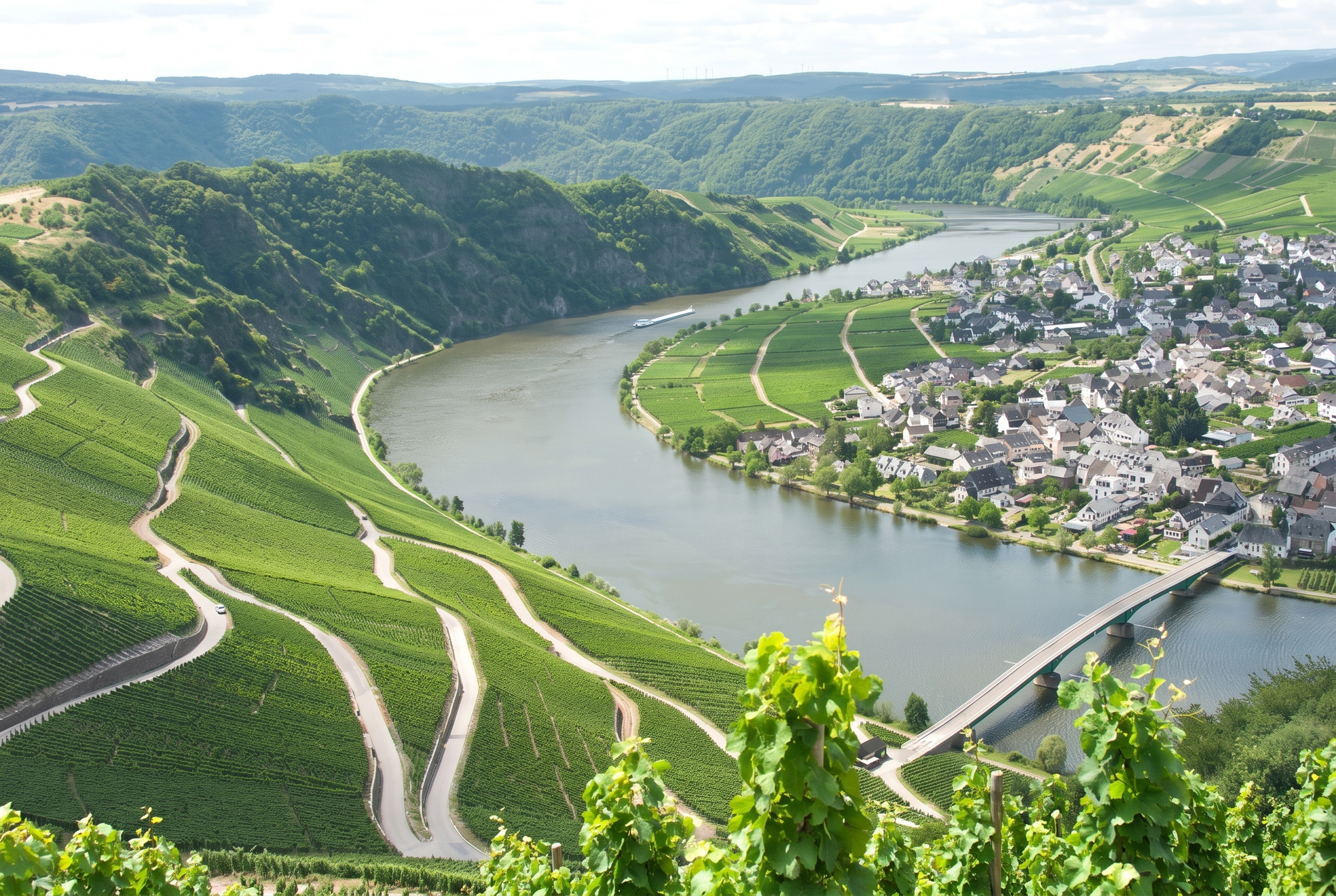
Harvest crews wear climbing harnesses here, and the Riesling repays the risk.
At a Glance
The Mosel is Germany's oldest wine region and its most dramatic. Vineyards climb slate slopes so steep that most work is done by hand, on terrain where a tractor would tip over. The reward is Riesling of a kind no other place makes: light, low in alcohol, electric with acidity, and able to age for decades.
Country: Germany
Main grapes: Riesling, Müller-Thurgau, Elbling, Spätburgunder (Pinot Noir)
Signature styles: Light dry and lightly sweet Riesling; rare dessert wines; sparkling Sekt
Climate: Cool continental, moderated by the Mosel, Saar, and Ruwer rivers
Key appellations: One protected origin, Mosel, covering the Middle Mosel (Bernkastel, Piesport, Wehlen), the terraced lower river, and the Saar and Ruwer valleys
Vineyard area:About 21,200 acres (8,600 hectares) as of 2022
Why It Matters
No region makes Riesling quite like this. A Mosel wine can carry 8 percent alcohol, a whisper of sweetness, and enough acidity to stay fresh for thirty years; nowhere else does so little weight deliver so much flavor. The best sites, Scharzhofberg and Wehlener Sonnenuhr among them, serve as reference points for the entire grape, and the steep slate slopes are the most recognizable vineyard landscape in Germany.
Land and Climate
The Mosel flows northeast from the French border to the Rhine at Koblenz, carving through hard Devonian slate the whole way. Each bend in the river creates a south-facing wall of rock, and that is where the vines go. The slate matters twice. It soaks up heat by day and releases it at night, coaxing grapes to full ripeness at the 50th parallel, roughly the latitude of Winnipeg. It also drains instantly, forcing roots deep and keeping yields modest.
Steepness is the other defining fact. Many sites exceed a 30 percent grade, and the Calmont near Bremm reaches about 65 degrees. Machines are useless there, so pruning and picking happen by hand, sometimes with winches and tiny rack railways. That labor shows up in the price and, more happily, in the glass, where cool air, long autumns, and stone combine into wines of unusual tension.
Grapes and Styles
Riesling covers about 62 percent of the vineyard (2022) and defines every serious style here. Dry versions, labeled trocken, taste of green apple, lime, and wet stone at 11 to 12.5 percent alcohol. Lightly sweet styles are the regional classic: a Kabinett, made from grapes picked at normal ripeness, may hold 8 percent alcohol and finish with a sweet-tart snap, while Spätlese, meaning late harvest, adds weight and peach flavor. In 2022, roughly six of every ten bottles the region submitted for official quality testing were in the sweet category, the highest share of any German region.
At the top sit dessert wines from shriveled or frozen grapes: Auslese, Beerenauslese, Trockenbeerenauslese, and Eiswein, all rare and very long-lived. Elbling, a tart white grown here since Roman times, rules the limestone of the upper river and makes brisk still and sparkling wine, called Sekt. Müller-Thurgau gives soft, simple everyday whites, and Spätburgunder (Pinot Noir) is a small but improving sideline. My one quarrel is with fashion rather than the wines: Kabinett remains the most refreshing wine style on earth, and it still sells for less than it deserves.
Reading the Label
German labels reward a little decoding. Qualitätswein means the wine passed an official test and comes entirely from the region. Prädikatswein adds a ripeness rank based on the sugar in the grapes at harvest, running from Kabinett up through Spätlese, Auslese, Beerenauslese, Eiswein, and Trockenbeerenauslese. Ripeness is not sweetness; a Spätlese can be fermented fully dry.
For sweetness, look for trocken (dry) or feinherb (off-dry). If neither appears on a Prädikat wine, expect noticeable sweetness. Alcohol is the best clue of all: 8 percent means sweet, 12 percent and up means dry. Village and vineyard follow a fixed pattern, so Wehlener Sonnenuhr is the Sonnenuhr site in the village of Wehlen. Grosses Gewächs, or GG, marks a dry wine from a top site as classified by the VDP, a national association of leading estates. Alte Reben means old vines.
A Short History
Romans planted the Mosel about two thousand years ago to supply Trier, then an imperial capital. Monasteries refined the craft through the Middle Ages, and Riesling gradually displaced lesser grapes. The late 1800s were the golden age, when top Mosel Rieslings commanded some of the highest wine prices in the world. The twentieth century brought war, sugary bulk imitations, and a long slide. A quality revival that began in the 1980s restored the region's standing, though steep-slope acreage keeps shrinking because the work is brutal.
Did You Know? The Calmont, rising between Bremm and Ediger-Eller, is Europe's steepest vineyard, with sections pitched near 65 degrees. Growers reach the vines by a via ferrata, a climbing route of ladders and steel cables, and haul gear on miniature rack railways. Goethe admired the site, describing it as “a natural amphitheatre.”
At the Table
Lightly sweet Mosel Riesling is the great spice wine. A Kabinett cools Thai curries and Sichuan heat because sugar buffers the burn while acidity scrubs the palate. Dry Riesling suits trout in butter, schnitzel, and sushi; locally it is poured with smoked pork and sauerkraut, where its brightness cuts the fat.
Serve dry versions at 46 to 50°F (8 to 10°C) and sweet ones a touch colder. Decanting is unnecessary for these fragile, aromatic wines. Aging is another matter: a good Spätlese from a strong vintage improves for twenty year.
Links
Official regional wine organization (Moselwein e.V.): https://www.weinland-mosel.de
Official regional tourism board: https://en.visitmosel.de
National wine institute (Wines of Germany / DWI): https://www.winesofgermany.com