

A hot alpine wind and buried limestone built the South Island's stealth fine-wine region.
At a Glance
North Canterbury begins an hour's drive north of Christchurch, with the Waipara Valley as its heart, where the Waipara River emerges from a limestone gorge onto old gravel terraces, and vines reaching inland to Waikari and out toward Banks Peninsula. It is a small, dry region with outsized ambitions: 94 vineyards (2023), most family-owned, making Riesling, Pinot Noir, and Chardonnay of national significance. Most cellar doors, the tasting rooms where wineries sell directly, sit within an easy drive of Christchurch's airport.
Country: New Zealand
Main grapes: Sauvignon Blanc, Pinot Noir, Riesling, Pinot Gris, Chardonnay
Signature styles: Dry-to-sweet Riesling; savory Pinot Noir; limestone-grown Chardonnay
Climate: Warm, dry; shaped by fohn winds
Key appellations: North Canterbury GI; Waipara Valley GI within it
Vineyard area: About 3,710 acres (1,501 hectares) in 2024
Why It Matters
This is New Zealand's Riesling stronghold and its most limestone-rich fine-wine district. Tiny inland vineyards at Waikari, planted on chalky hills, produce Pinot Noir and Chardonnay that collectors chase at Burgundy prices, while Waipara's family wineries keep the everyday bottles honest. The region is standing proof that Canterbury, long dismissed as too cool for wine, can make some of the country's most distinctive bottles.
Land and Climate
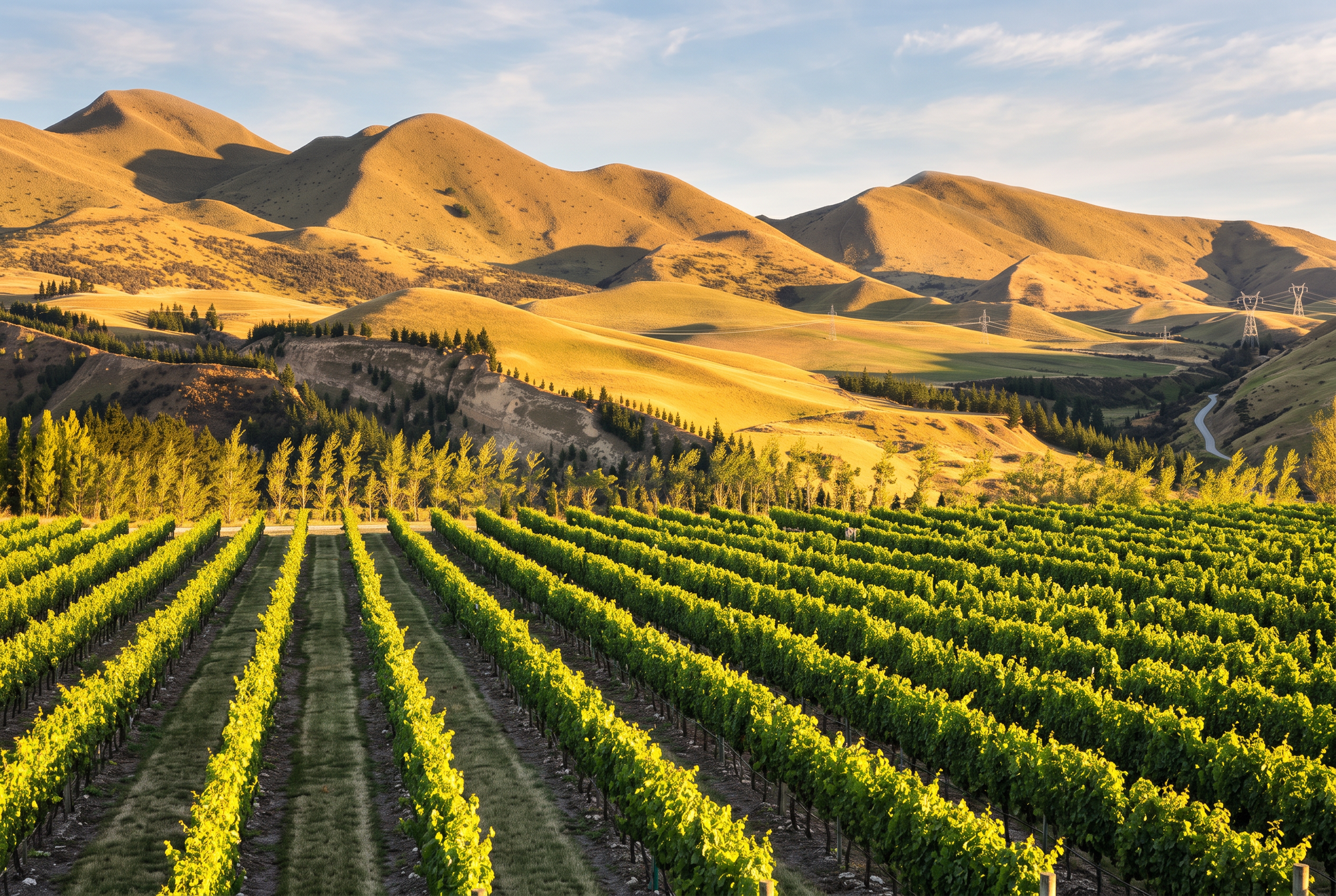
Two forces shape everything. The low Teviotdale Hills block cold Pacific easterlies, and the nor'wester, a fohn wind (air that drops its rain on the Southern Alps, then descends hot and dry), bakes the valley in summer. Together they make Waipara warmer and drier than the plains around Christchurch, with long, settled autumns that give grapes some of the longest hang time in New Zealand: extra weeks ripening on the vine, building flavor at modest sugar levels. Frost is the tax on all this, and wind machines dot the vineyards. Soils split into two families with audible consequences in the glass. Free-draining river gravels on the valley floor, the Glasnevin Gravels, give bright, fruit-driven wines. Limestone-laced clay on the Omihi hills and at Waikari gives tighter, chalk-textured Pinot Noir and Chardonnay. Annual rainfall of roughly 24 to 28 inches (600 to 700 millimeters) ranks among the lowest of any New Zealand wine region.
Grapes and Styles
Riesling is the signature even though it is not the biggest planting: about 640 acres (258 hectares) in 2024, made in every register from stony-dry to fully sweet, with lime and honey flavors that deepen for a decade or two. One term worth decoding: 'off-dry' means a touch of sweetness, balanced here by acidity so firm the wines rarely taste sugary. Pinot Noir, about 1,015 acres (410 hectares), splits by soil: supple and cherried from the gravels, savory and chalky from the limestone. The gravel wines drink earlier, while the limestone bottlings want three or four years of patience. Pound for pound, this is New Zealand's best-value Pinot Noir.
Sauvignon Blanc is quietly the largest planting at about 1,150 acres (465 hectares) in 2024, in a riper, sour-citrus style quite unlike Marlborough's. Chardonnay is small, about 227 acres (92 hectares), but the limestone bottlings from Waikari rank with the country's finest. Pinot Gris adds spiced pear, and Gewurztraminer persists in pockets.
Reading the Label
'North Canterbury' is the regional Geographical Indication (GI), a protected statement of where the grapes grew, with no rules on style. 'Waipara Valley' is a registered GI inside it and the name you will see most often. Read carefully: Waipara, in Canterbury, is not Wairarapa, a separate region in the North Island; the near-identical spellings confuse everyone. The 85 percent rule applies to any region, variety, or vintage claim on the label. Sub-zone names such as Omihi or Glasnevin rarely appear on bottles, so among the region's ninety-odd small vineyards (2023) the producer's name tells you more than any geographic term below 'Waipara.'
A Short History
Canterbury's modern era opened near Christchurch in 1978, when St Helena planted what became the area's first commercial winery; its 1982 Pinot Noir won national gold medals and startled the industry. Growers soon moved to the sheltered Waipara Valley, planting from the early 1980s, and Riesling quickly became the valley's first claim to fame. Around the turn of the millennium, Bell Hill and Pyramid Valley pushed inland onto the Waikari limestone and gave the region its cult tier. The district has since consolidated under the North Canterbury banner, pulling Waipara, Waikari, and the outlying plains vineyards into one identity.
Did you know? New Zealand's biggest Riesling region is not Marlborough. North Canterbury's 638 acres (258 hectares) of Riesling in 2024 beat Marlborough's 202 hectares, from a total vineyard one-twentieth Marlborough's size.
At the Table
Dry Riesling with pork belly is the regional party trick, and off-dry versions tame Thai and Vietnamese heat better than almost any wine. Aged Riesling, honeyed and toasty, suits roast chicken. Pinot Noir wants duck, Canterbury lamb, or mushroom dishes; serve it at 57 to 61 F (14 to 16 C) and give sturdy young limestone bottlings a short decant. Serve Riesling at 46 to 50 F (8 to 10 C). Good examples of both keep for ten to twenty years. The local larder leans the same way as the wine: the district farms venison and lamb and even hosts a truffle plantation, and its annual wine and food festival celebrates the lot under the summer oaks.
Links
North Canterbury Winegrowers (regional body): https://www.northcanterburywines.co.nz
Visit Hurunui (official district tourism): https://visithurunui.co.nz