

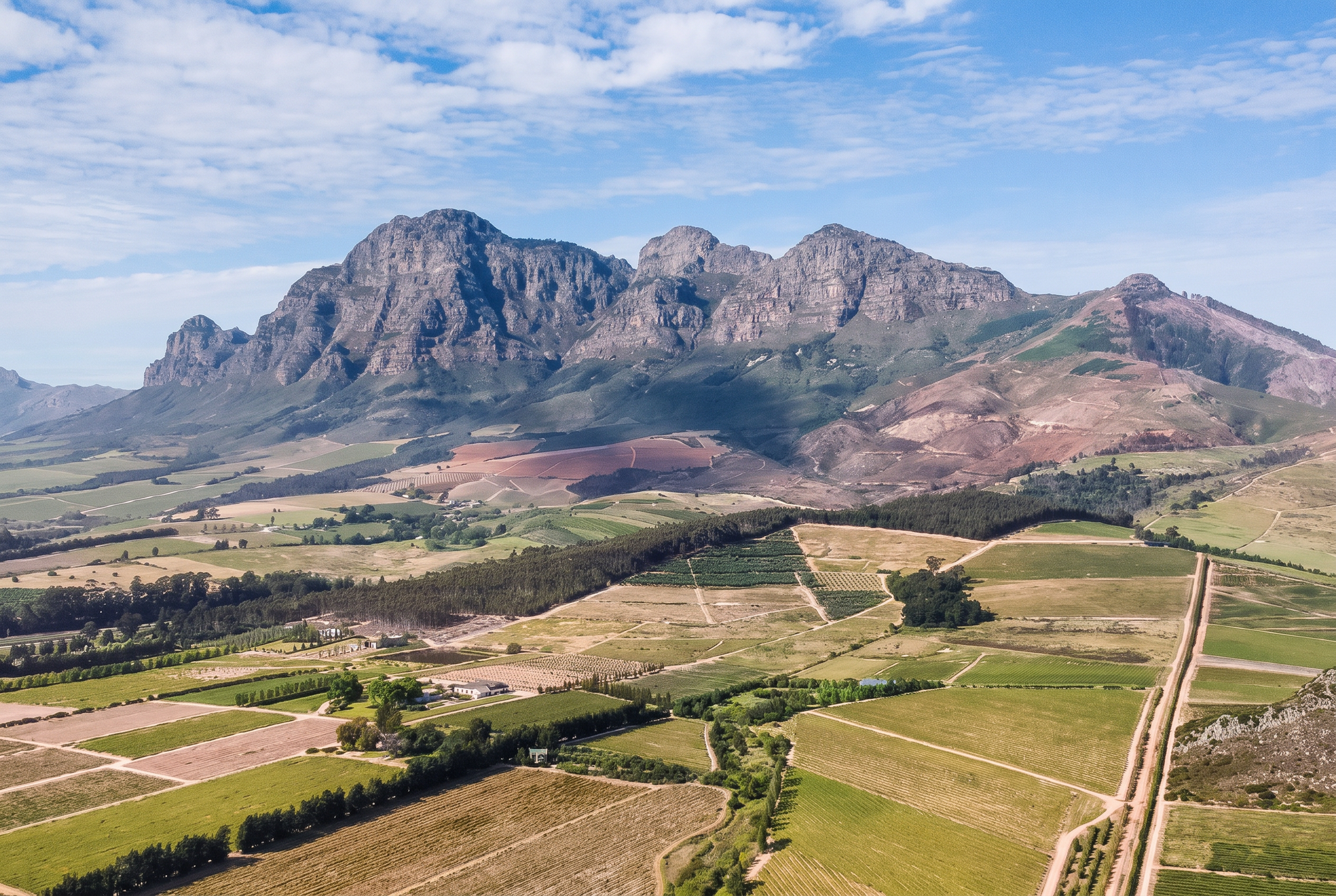
A giant granite pearl watches over the valley that once ran South African wine.
1. At a Glance
Paarl spreads along the Berg River about 35 miles (60 kilometers) northeast of Cape Town, beneath the huge rounded granite domes of Paarl Mountain that gleam like a pearl after rain and gave the town its Dutch name. For most of the 20th century this was the administrative heart of the whole industry. Today it is a warm-climate district known for Shiraz, Chenin Blanc, and honest value. The town itself, one of the Cape's oldest, strings along a 7-mile (11-kilometer) main road beneath the mountain, with wine farms starting at its edges and more than 30 cellars open to visitors.
Country: South Africa
Main grapes: Chenin Blanc, Syrah (Shiraz), Cabernet Sauvignon, Pinotage, Merlot, Grenache, Viognier
Signature styles: Spicy, full-bodied Shiraz, old-vine Chenin Blanc, Rhône-style blends, brandy and fortified wines
Climate: Warm Mediterranean; long, hot summers with limited ocean influence
Key appellations: Wine of Origin Paarl; wards include Simonsberg-Paarl, Voor Paardeberg, Agter-Paarl
Vineyard area: About 34,300 acres (13,900 hectares) in 2024 for the SAWIS statistical region, which counts Paarl together with Franschhoek, Wellington, and Tulbagh
2. Why It Matters
Paarl ran South African wine for most of a century. The KWV, the national cooperative founded here in 1918, set prices and quotas for the entire industry from its Paarl headquarters, and the town still hosts the Nederburg Auction, the country's marquee fine-wine sale. Beyond the institutions, Paarl matters in the glass: its warm slopes produce some of the Cape's most reliable Shiraz and a deep bench of old-vine Chenin Blanc.
3. Land and Climate
Paarl sits farther from the ocean than Stellenbosch, so the cooling afternoon breeze arrives later and weaker. Summers are long and hot, which ripens red grapes fully and explains the district's plush, generous style. Annual rainfall of roughly 26 inches (650 millimeters) falls mostly in winter, and the Berg River supplies irrigation where summers bite. Soils sort into three broad bands, each with a consequence. Decomposed granite around Paarl Mountain and on the Paardeberg drains sharply and holds few nutrients, so vines yield small crops of concentrated fruit; this is prime Shiraz and Chenin ground. Sandstone-derived soils along the river run sandier and give lighter, earlier-drinking wines. Weathered shale to the northeast retains more water and produces broader, riper flavors. Altitude on the Simonsberg foothills adds cooler nights, which keep the best reds fresh.
4. Grapes and Styles
Shiraz is the specialty: dark plum, black pepper, and smoked-meat flavors with soft, mouth-filling tannins, riper in style than Swartland versions from just to the north. Cabernet Sauvignon, Merlot, and Pinotage fill out the reds, and Rhône-style blends built on Grenache and Mourvèdre are increasingly common. Among whites, Chenin Blanc leads, especially from old, untrellised bush vines on the Voor Paardeberg side, giving quince and honey flavors with real breadth. Viognier and Chardonnay supply aromatic and richer options. Paarl's long fortified tradition survives too: Port-style sweet reds, sherry-style wines, and above all brandy, which the KWV made a national product; its cathedral-vaulted barrel cellar in town remains a landmark. Expect the reds to be riper and rounder than Stellenbosch equivalents, with softer acidity, which makes them approachable young. A mild opinion to close: for serious red wine at a fair price, Paarl beats every glamorous neighbor it has.
5. Reading the Label
"Wine of Origin Paarl" ("W.O. Paarl") certifies that all grapes grew in the district; the Wine of Origin system is South Africa's government-run origin scheme dating from 1973. Ward names on labels, such as Simonsberg-Paarl or Voor Paardeberg, point to smaller demarcated zones with their own character. A listed grape or vintage must be at least 85 percent of the wine. You will also see "W.O. Coastal Region" on bottles from Paarl producers; that broader term legally allows blending across Paarl, Stellenbosch, Swartland, and other coastal districts, so it tells you less about the vineyard. "Estate Wine" still means grown, made, and bottled on one registered property, and the numbered certification seal over the capsule shows the claims were audited. Wellington and Franschhoek, once counted as parts of Paarl, are now separate districts, so older references and newer labels can disagree.
6. A Short History
French Huguenot refugees planted vines here in the 1680s, and Paarl grew into a farming hub on the Berg River. The founding of the KWV cooperative in 1918 made the town the industry's seat of power through the quota decades. Paarl was among the first districts demarcated when the Wine of Origin system arrived in the early 1970s. Deregulation in the 1990s ended KWV's control and let independent Paarl estates compete on quality.
Did You Know? Nelson Mandela walked to freedom in Paarl. He spent his final prison years at Victor Verster prison among the district's vineyards, and on February 11, 1990 he walked out of its gates before the world's cameras. A bronze statue of Mandela, fist raised, marks the spot today.
7. At the Table
Paarl Shiraz belongs next to boerewors, the coiled, spiced farmer's sausage that anchors a South African braai, and it handles oxtail or short ribs just as well. Chenin Blanc pairs with Cape Malay curries and pickled fish, cutting the spice with fruit and acidity. Serve reds at 60 to 65 degrees Fahrenheit (16 to 18 Celsius); an hour in a decanter helps young Shiraz unwind. Whites are best at 46 to 50 Fahrenheit (8 to 10 Celsius). Most Paarl reds peak within 5 to 10 years, and a glass of the local brandy is the traditional way to end the meal.
Links
Paarl Wine Route (producers' association): https://www.paarlwineroute.co.za
Wines of South Africa (national promotion body): https://www.wosa.co.za
SAWIS (industry statistics and Wine of Origin administration): https://www.sawis.co.za