

Two wine valleys in one, split by thirty miles with no vines.
1. At a Glance
The Rhône Valley runs about 150 miles (240 kilometers) down its namesake river, from Vienne just south of Lyon to Avignon. It is really two regions wearing one name: a steep granite north where Syrah rules alone, and a vast, sun-baked Mediterranean south built on Grenache blends. Together they covered about 156,400 acres (63,300 hectares) as of 2024, making this France's second-largest appellation region after Bordeaux.
Country: France
Main grapes: Syrah, Grenache, Mourvèdre, Cinsault; Viognier, Marsanne, Roussanne, Grenache Blanc for whites
Signature styles: Powerful reds, aromatic whites, Tavel rosé, fortified sweet Muscat
Climate Continental in the north, Mediterranean in the south
Key appellations Côte-Rôtie, Condrieu, Hermitage, Cornas; Côtes du Rhône and Villages, Châteauneuf-du-Pape, Gigondas, Vacqueyras, Tavel
Vineyard area About 156,400 acres (63,300 hectares) as of 2024, per Inter Rhône
2. Why It Matters
This is Syrah's homeland and benchmark: Hermitage and Côte-Rôtie define what the grape can be, and the world's Shiraz descends from these hills. The south created the Grenache-Syrah-Mourvèdre blend that half the warm-climate world now copies, while Côtes du Rhône supplies France's everyday red; the whole valley produced about 2.2 million hectoliters, close to 290 million bottles, in 2024. The modern appellation system itself was drafted here, at Châteauneuf-du-Pape.
3. Land and Climate
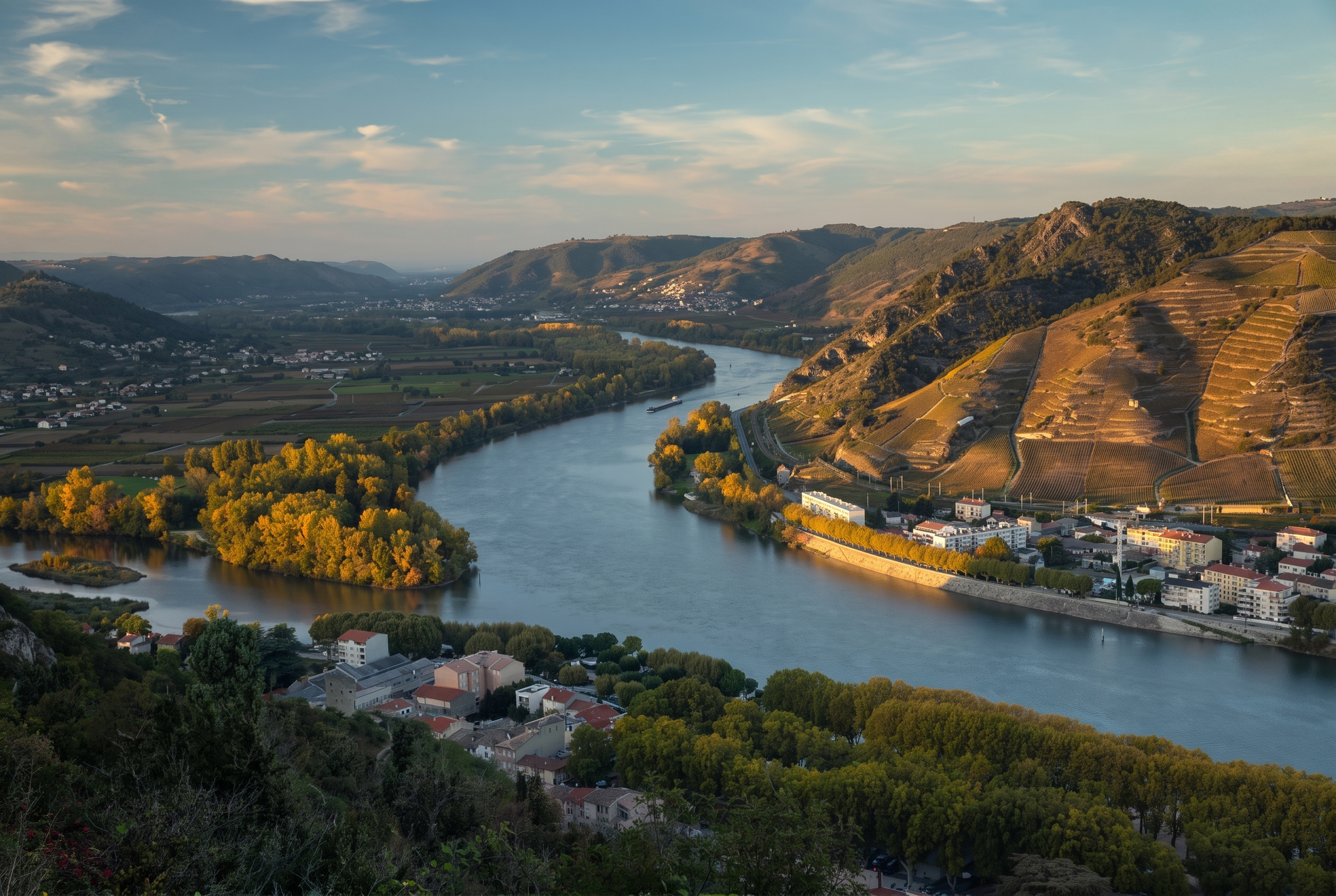
Start with the gap: for roughly 30 miles (50 kilometers) between Valence and Montélimar, there are almost no classified vines. It splits the valley into two climates, and two scales: the south accounts for the overwhelming majority of production, the north for most of the mystique. The north is a narrow granite gorge with a continental climate; Syrah grows on terraces so steep they are worked by hand and held up by dry-stone walls. Granite, wind, and cool nights produce savory, peppery wines with real structure, from only about 9,900 acres (4,000 hectares) in total (2020s figures).
The south opens into a wide Mediterranean basin with about 2,800 hours of annual sunshine. The mistral, the valley's cold and violent north wind, dries the vines, keeping fruit healthy, but stresses them too. At Châteauneuf-du-Pape, rounded quartzite stones called galets roulés soak up daytime heat and radiate it at night, while clay beneath holds water. The result is ripe, generous Grenache.
4. Grapes and Styles
Northern reds are Syrah, sometimes with a splash of white grapes: violets, black pepper, olive, and an iron-like savor. Cornas is the brawler, Côte-Rôtie the perfumed one, Hermitage the monument; Crozes-Hermitage and Saint-Joseph are the affordable doors in. Northern whites mean Condrieu, heady apricot-scented Viognier for drinking young, and long-lived Marsanne-Roussanne blends.
Southern reds are Grenache-led blends with Syrah and Mourvèdre: raspberry, herbs, spice, and warmth. Châteauneuf-du-Pape may use 13 varieties; Gigondas and Vacqueyras deliver similar muscle for less money, and the cooler slopes of Ventoux and Luberon on the valley's eastern edge are a happy hunting ground for bargains. Tavel makes only rosé, dark and gastronomic. Muscat de Beaumes-de-Venise and Rasteau add fortified sweet wines, and the valley even makes sparkling wine, in Saint-Péray in the north and grapey, gently sweet Clairette de Die in the Drôme hills. The smartest buying in the valley, in my view, is Côtes du Rhône Villages with a named village attached.
5. Reading the Label
Each step of the southern pyramid is an appellation, a legally defined zone with its own rules. Côtes du Rhône sits at the base (about 74,000 acres, or 30,000 hectares, in the 2020s), then Côtes du Rhône Villages, then Villages with one of roughly twenty named villages attached, then the crus at the top; Laudun, promoted in 2024, is the newest cru.
Here is the practical trick: the top wines drop "Côtes du Rhône" from the label entirely. A bottle saying only Gigondas, Cornas, or Châteauneuf-du-Pape is cru Rhône. "Réserve" and "Vieilles vignes" carry no legal weight. On northern labels, a lieu-dit such as La Landonne names a single celebrated slope.
6. A Short History
Romans terraced the hills at Vienne by the first century AD. The papal court at Avignon in the 14th century planted Châteauneuf and gave the wines prestige. For centuries Rhône reds were quietly shipped north to beef up thinner Bordeaux and Burgundy, a practice so common that strengthened clarets were sold as "hermitaged." In 1737 a royal decree ordered local barrels branded "C.D.R.", an early stab at origin protection. The decisive turn came in 1923, when Baron Le Roy organized Châteauneuf-du-Pape's growers around strict production rules; they became the template for the national AOC system created in the 1930s.
Did You Know? In October 1954, at the height of a French flying-saucer craze, the mayor of Châteauneuf-du-Pape issued a municipal decree banning flying saucers and "cigar-shaped craft" from landing in the commune; any that did were to be impounded. The decree has never been repealed, and no violations have been recorded.
7. At the Table
Northern Syrah wants pepper and char: steak au poivre, grilled beef, game birds. Condrieu is a special-occasion match for scallops or lobster. In the south, Châteauneuf and Gigondas belong with lamb daube, beef stews, black-truffle dishes from the nearby Tricastin, and hard sheep's cheeses, and Tavel is one of the few rosés with the weight for bouillabaisse or charcuterie boards.
Serve the big southern reds at 61 to 64°F (16 to 18°C) and decant young Hermitage, Cornas, or Châteauneuf for one to two hours. Basic Côtes du Rhône is ready on release; the crus run 10 to 30 years in good vintages.
Links
Inter Rhône (regulatory body): https://www.vins-rhone.com/
Inter Rhône Key Figures 2024, statistics booklet (PDF): https://www.vins-rhone.com/sites/vignoble/files/documentation/2025-04/INTER-RHONE-CHIFFRES-CLES-2025-EN-BAT.pdf