

Limestone soils almost unheard of elsewhere in South Africa make this Chardonnay country.
1. At a Glance
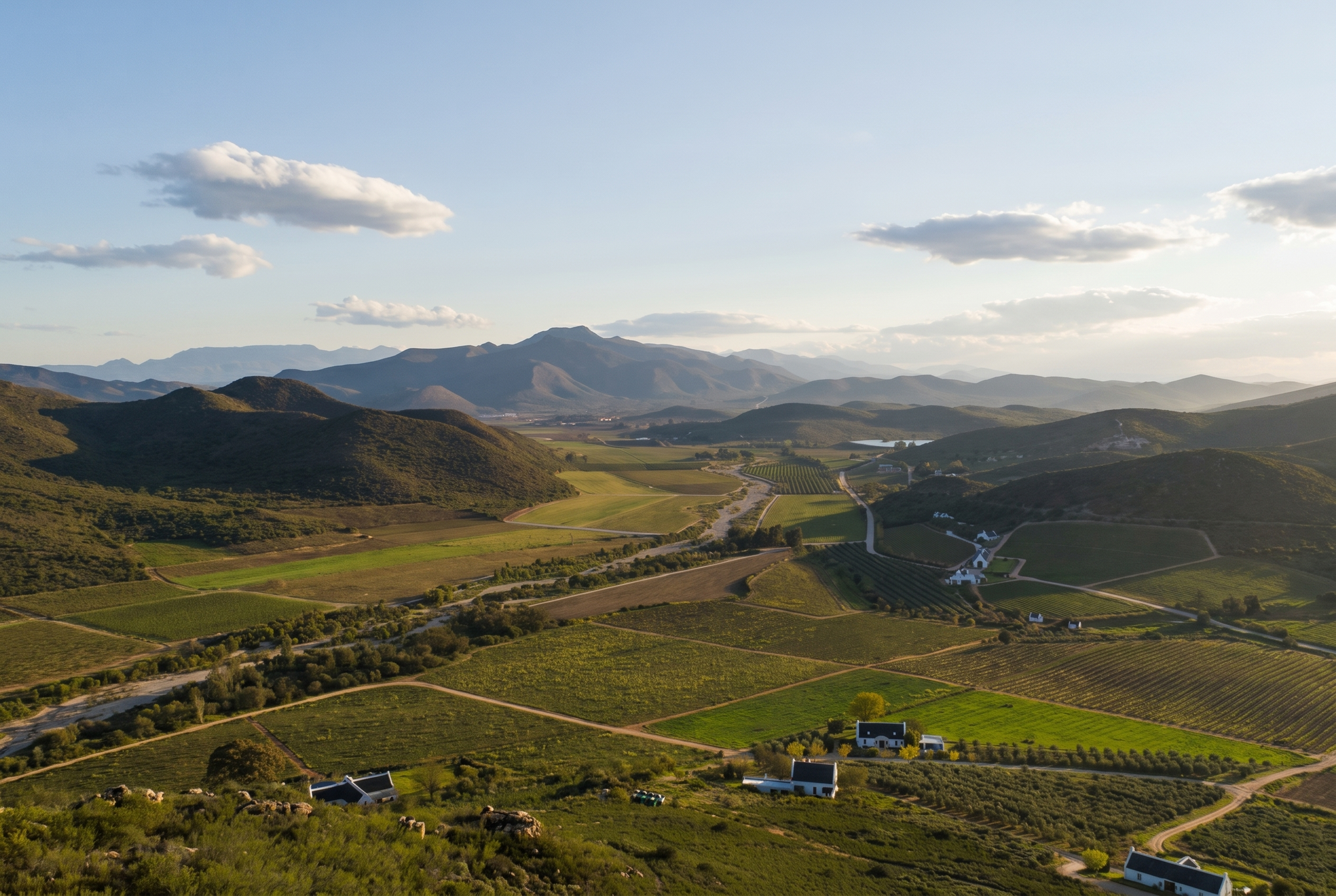
Robertson lies inland, about 100 miles (160 kilometers) east of Cape Town along the Breede River, on Route 62 between the Langeberg mountains and the fringe of the Karoo semi-desert. Locals call it the valley of wine and roses. It is hot, dry, irrigated farmland that happens to hide pockets of limestone, and that quirk of geology built its reputation for Chardonnay and sparkling wine. About 40 wineries open their doors along the route, ranging from family estates to some of the largest cooperative cellars in the country, and prices stay friendlier than anywhere on the coast.
Country: South Africa
Main grapes: Chardonnay, Sauvignon Blanc, Colombard, Chenin Blanc, Syrah (Shiraz), Cabernet Sauvignon, Pinot Noir
Signature styles: Chardonnay (still and sparkling), Cap Classique, fresh whites, plush reds, fortified Muscadel
Climate: Hot and dry; big day-to-night temperature swings, cooled by southeasterly winds
Key appellations: Wine of Origin Robertson, a district of the Breede River Valley region; wards include Bonnievale, McGregor, Eilandia
Vineyard area: About 31,600 acres (12,800 hectares) as of 2024 (SAWIS)
2. Why It Matters
Robertson is South Africa's Chardonnay engine and one of its great value sources. The district's limestone-flecked soils, rare in a country built on granite and shale, give the grape a chalky freshness that drew comparisons to France's Chablis region long before the marketing caught up. Producers such as Graham Beck and De Wetshof turned that advantage into internationally known sparkling and still Chardonnays, while the valley's cooperatives keep supermarket shelves stocked worldwide.
3. Land and Climate
The numbers say desert-adjacent: roughly 16 inches (400 millimeters) of rain a year, far too little for unirrigated vines, so nearly every vineyard drinks from the Breede River and its dams. Summers are hot, but two forces pull quality out of the heat. Southeasterly winds funnel up the valley from the Indian Ocean on summer afternoons, and clear skies let nighttime temperatures plunge, so grapes keep acidity while ripening fully. The Langeberg range walls off the true Karoo semi-desert to the north. Soils decide what gets planted where. Fertile alluvial ground near the river supports generous reds and high-volume whites. Red, gravelly Karoo-edge soils suit tighter whites. The prize is the scattered limestone: its high lime content stresses vines slightly and shows up in the glass as the chalky, mineral cut that defines top Robertson Chardonnay.
4. Grapes and Styles
Chardonnay leads, in two guises. Still versions run from unoaked, citrus-and-chalk styles to barrel-fermented wines with peach and hazelnut depth. Sparkling versions go into Cap Classique, South Africa's bottle-fermented sparkling wine made by the same method as Champagne, usually blended with Pinot Noir; Robertson is one of its most important sources. Sauvignon Blanc is crisp and sunny, and Colombard, a workhorse white once grown mainly for brandy distillation, makes cheerful, tangy everyday wine. Chenin Blanc fills a similar role with more texture. Reds are plusher than coastal versions: ripe, rounded Shiraz and Cabernet Sauvignon built for early drinking. Pinot Noir, grown mainly for the sparkling blends, increasingly appears as a light red in its own right. Muscadel, the old local specialty, is a fortified sweet Muscat, meaning grape spirit is added to stop fermentation and preserve sugar. Served cold, it is one of the Cape's underrated pleasures, and that is this article's one opinion.
5. Reading the Label
"Wine of Origin Robertson" ("W.O. Robertson") certifies 100 percent Robertson grapes under the Wine of Origin system, South Africa's government-run origin scheme in force since 1973. Robertson is a district inside the larger Breede River Valley region, so some blends carry that broader regional name instead. Ward names such as Bonnievale or McGregor flag smaller demarcated areas. A stated variety or vintage must be at least 85 percent of the wine, and "Estate Wine" means one registered property grew, made, and bottled it. On sparkling bottles, look for the words Cap Classique; carbonated bulk fizz cannot use the term. The numbered certification seal over the capsule confirms every claim was audited, which is worth remembering in a district where the same grape spans supermarket blends and single-vineyard bottlings.
6. A Short History
The town was founded in 1852 in sheep-farming country, and for its first century the wine industry here fed the brandy and fortified-wine trade, with cooperatives handling most of the crop. The pivot came in the late 20th century, when estates proved the limestone soils could carry serious Chardonnay and, from the 1990s, Cap Classique. The district has since grown from a bulk supplier into a destination, helped by the annual Wacky Wine Weekend festival on Route 62.
Did You Know? Robertson's calling card is geological luck. Significant limestone in vineyard soil is almost unheard of in South Africa, yet this valley has pockets of it, which is why wine references reach for comparisons with Chablis when describing Robertson Chardonnay, and why racehorse studs thrive on the same calcium-rich pastures.
7. At the Table
Unoaked Robertson Chardonnay and Sauvignon Blanc suit river fish, smoked snoek pâté, and salads; serve them at 46 to 50 degrees Fahrenheit (8 to 10 Celsius). Barrel-fermented Chardonnay steps up to roast chicken or creamy pasta. Cap Classique at 43 to 46 Fahrenheit (6 to 8 Celsius) opens a meal or carries a celebration. The soft reds need no decanting and drink best within five years at about 62 Fahrenheit (17 Celsius). Finish with chilled red Muscadel alongside malva pudding, the Cape's sticky apricot sponge dessert; the pairing is a local institution.
Links
Robertson Wine Valley (producers' association): https://www.robertsonwinevalley.com
Wines of South Africa (national promotion body): https://www.wosa.co.za
SAWIS (industry statistics and Wine of Origin administration): https://www.sawis.co.za