

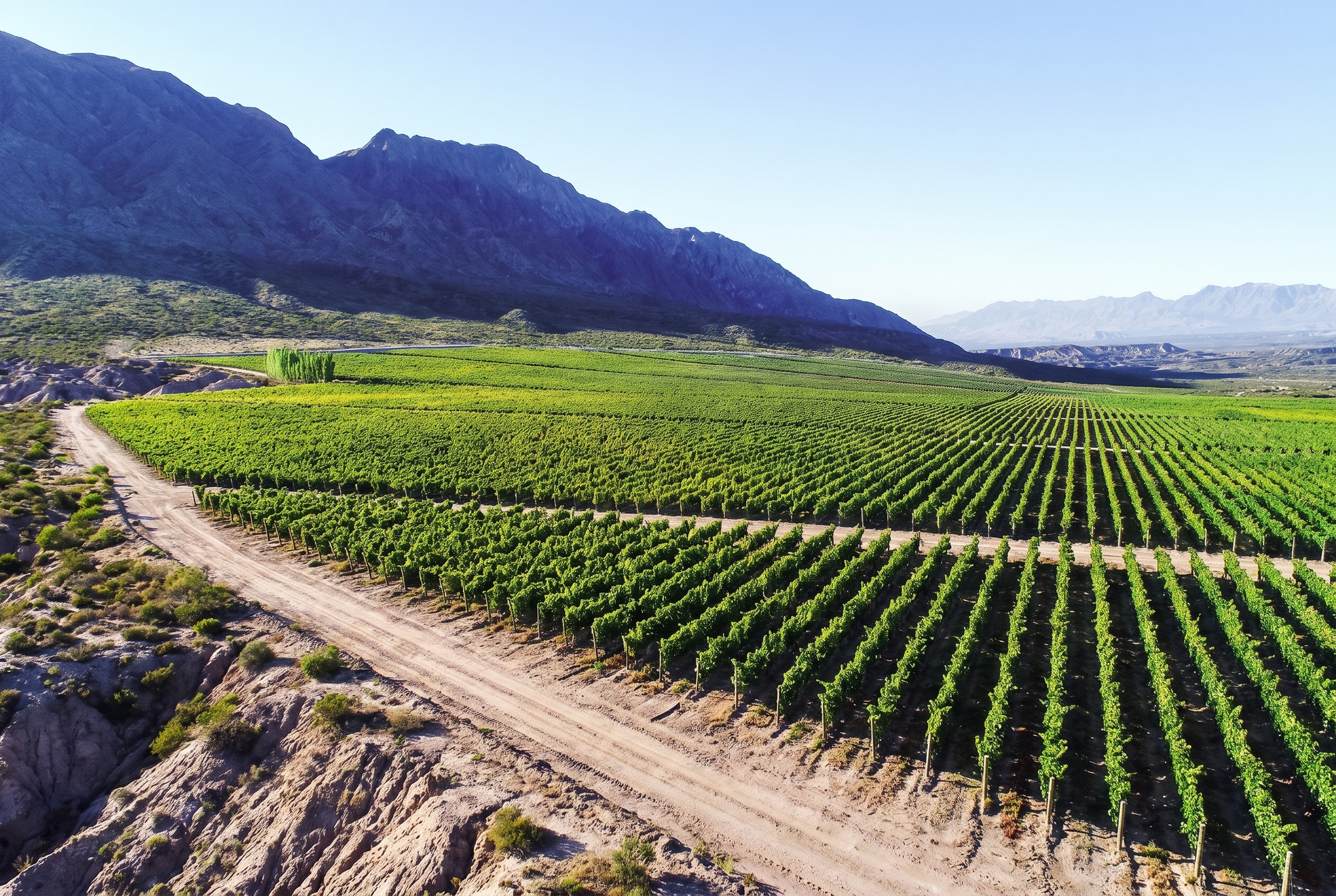
Roughly half the farmland in this hot desert province is planted with vines.
1. At a Glance
San Juan lies directly north of Mendoza, hotter and lower, and even drier, its vineyards strung through a series of desert valleys between Andean foothills. For a century it served as Argentina's volume cellar, supplying everyday wine, raisins, and grape concentrate. That is still much of the business, but the province has built a second identity around Syrah, and around Pedernal, a cool limestone valley producing some of the country's most distinctive reds. The INV, Argentina's national wine regulator, recorded about 39,600 hectares (97,900 acres) of vines in 2024, nearly 20 percent of the national total, a figure that includes table and raisin grapes.
Country: Argentina
Main grapes: Syrah, Malbec, Bonarda, Pedro Giménez, Chardonnay
Signature styles: Ripe, peppery Syrah; everyday reds and whites; fortified and vermouth base wines
Climate: Hot desert; about 5 inches (130 mm) of rain in the main valley
Key appellations: Tulum, Zonda, Ullum, Pedernal, and Calingasta valleys
Vineyard area: About 39,600 hectares / 97,900 acres, including table and raisin grapes (2024, INV)
2. Why It Matters
San Juan is Argentina's second wine province by every measure, and its Syrah is the closest thing the country has to a second red signature after Malbec. The province also carries Argentina's tradition of fortified wines (wines strengthened with grape spirit), vermouth, and brandy, all built on hot, reliable harvests. For most drinkers San Juan means value; for the curious, Pedernal is the name to remember.
3. Land and Climate
Mountains cover more than 80 percent of San Juan, so vines squeeze into irrigated valley floors. The Tulum Valley, around the provincial capital, is the workhorse: 2,000 to 3,000 feet (600 to 900 meters) up, very hot, and nearly rainless at about 5 inches (130 mm) a year. The Pie de Palo hills close the valley to the east, the San Juan River curves through it, and everything drinks Andean snowmelt. Heat means generous ripeness, soft tannins, and wines ready young. The Zonda and Ullum valleys just west sit slightly higher and behave as a bridge to the mountain sites; remote Calingasta, higher still, is drawing new plantings.
The province's wild card is the zonda, a hot, dry wind that roars down from the Andes at highway speeds. It stresses vines and cuts yields, but it also keeps the air so dry that mildew and rot barely exist. Quality farming has moved uphill to match: the Pedernal Valley, at 4,100 to 4,900 feet (1,250 to 1,500 meters) on limestone-strewn soils, is cold at night and stingy by nature, and its wines carry a tension the valley floor cannot match.
4. Grapes and Styles
Syrah is the calling card. San Juan versions are deep purple and full-bodied, black plum and blueberry with the grape's telltale crack of black pepper. From the hot Tulum floor they are friendly and immediate; from Pedernal they turn firmer and more savory. Pedernal Syrah is, to my palate, the most underrated red in Argentina. Malbec and Bonarda, Argentina's juicy second red grape, fill out the list, with Cabernet Sauvignon and Tannat in support.
Whites lean historic. Pedro Giménez, a neutral local grape, remains widely planted for simple wines and for the base of vermouth and brandy. Chardonnay and Viognier lead the modern whites, best from higher, cooler sites, and inexpensive rosé is a growing sideline.
The old fortified tradition survives as well: sweet, sherry-style bottlings that locals pour as aperitifs, a category best tried at the source. Keep in mind that San Juan is also Argentina's raisin and table-grape capital, which explains the gap between its enormous vineyard and its more modest fine-wine fame.
5. Reading the Label
A named grape means at least 85 percent of that variety, by national law. Origin appears as an IG, short for Indicación Geográfica, a protected geographic indication. “San Juan” alone usually signals blended valley-floor fruit; a specific valley, whether Valle de Tulum, Valle de Zonda, or Valle del Pedernal, signals more ambition, and Pedernal in particular is a reliable quality marker. “Reserva” guarantees 12 months of aging for reds and 6 for whites; “Gran Reserva” doubles that. Words like “Selección” or “Premium” carry no legal weight.
6. A Short History
Vines arrived with Spanish colonists in the late 1500s, and San Juan grew into the country's second cellar during the immigration boom of the late 1800s. Through the 20th century it specialized in bulk wine, raisins, and concentrate, and paid for it when domestic consumption collapsed; the province lost 16 percent of its vineyard between 2015 and 2024 alone (INV). The counter-move began in the 1990s and 2000s, when producers planted Syrah in earnest and opened up the high Pedernal Valley, where roughly 850 hectares (2,100 acres) of vines now sit on limestone.Did You Know? About half of San Juan's agricultural land is planted with grapevines, a level of dependence on a single crop with few parallels anywhere in wine. The province even has a valley named Zonda, after the same scorching mountain wind that growers brace against every spring.
7. At the Table
Syrah's pepper and dark fruit suit anything grilled over wood: chorizo, ribs, kid goat, portobello mushrooms. Everyday bottles want no ceremony; serve them at 60 to 64°F (16 to 18°C) and drink them within four years. Pedernal reds repay 30 minutes in a decanter and hold for eight to ten. The fortified wines shine chilled before dinner alongside salted almonds or hard cheese. And if you find a crisp San Juan Viognier or Chardonnay, it will handle empanadas and creamy dishes better than you might expect.
Links
National wine regulator (INV): https://www.argentina.gob.ar/inv
Official tourism board (Visit Argentina): https://www.argentina.travel
Wines of Argentina, San Juan profile: https://winesofargentina.org/en/provinces/san-juan