

This island makes under one percent of Australia's wine but four percent of its value.
1. At a Glance
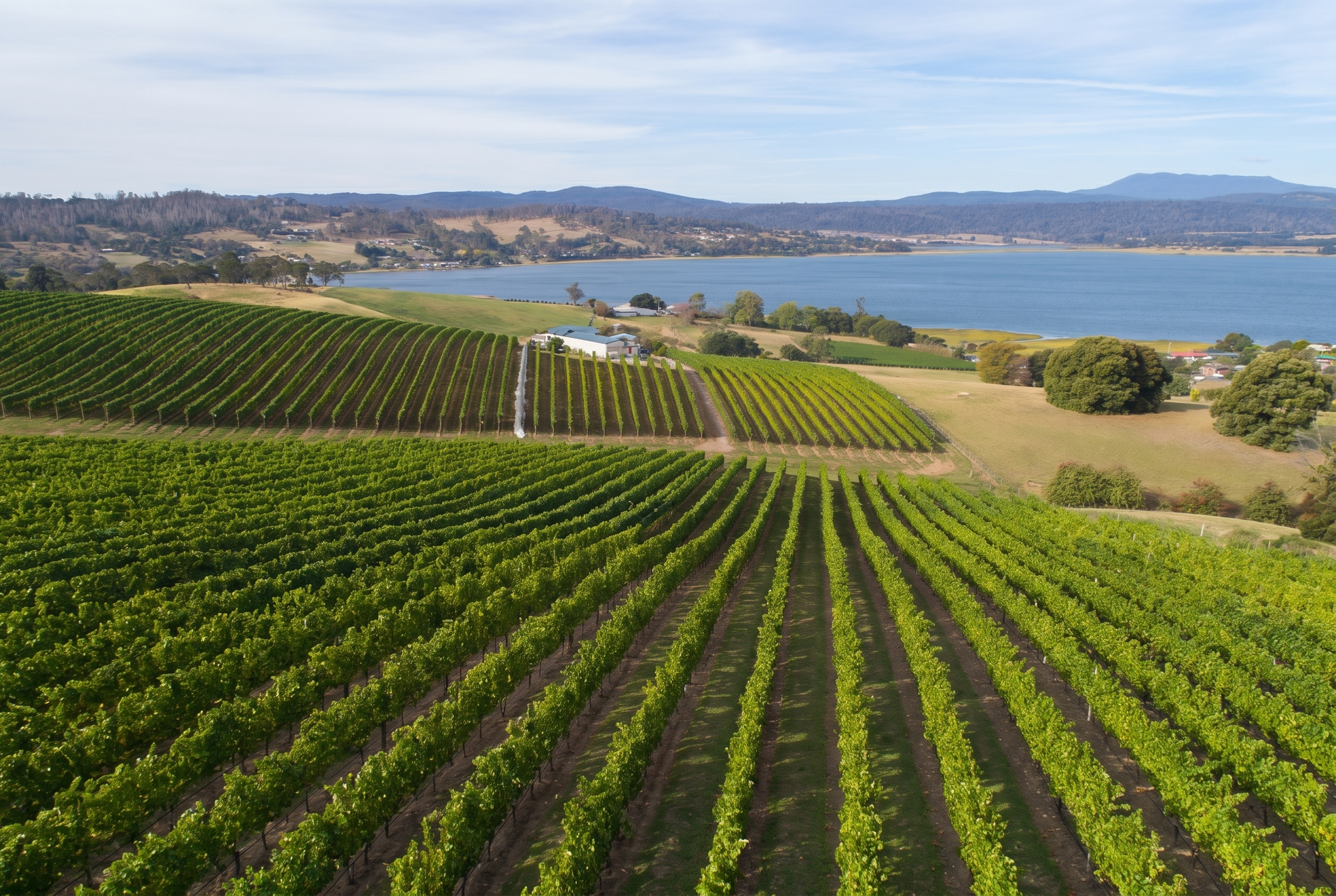
Tasmania, the island state south of the Australian mainland, is the country's coolest wine region, sitting between 40 and 44 degrees south in the path of the Roaring Forties winds. The whole island operates as a single official region, producing traditional-method sparkling wine, Pinot Noir, Chardonnay, and Riesling that command the highest grape prices in Australia, from around 160 mostly small producers clustered in the island's drier north and southeast.
Country: Australia
Main grapes: Pinot Noir, Chardonnay, Pinot Gris, Sauvignon Blanc, Riesling
Signature styles: Traditional-method sparkling; fragrant Pinot Noir; taut Chardonnay and Riesling
Climate: Cool maritime; the lowest mean January temperature of any Australian region, about 60°F (15.6°C)
Key appellations: Tasmania GI (whole island); informal areas include Tamar Valley, Pipers River, Coal River Valley
Vineyard area: About 5,150 acres (2,084 hectares), 2024 Wine Australia snapshot
2. Why It Matters
Tasmania is Australian wine's quality outlier. It produces less than 1 percent of the nation's wine by volume yet more than 4 percent of its value, and its grapes fetch prices several times the national average. Its sparkling wines, led by houses like Arras and Jansz, win international championships against Champagne, mainland producers quietly buy Tasmanian fruit for their best fizz, and a warming climate is steadily working in the island's favor rather than against it.
3. Land and Climate
Cool is the whole identity. Tasmania records the lowest mean January (midsummer) temperature of any Australian wine region, about 60 degrees Fahrenheit (15.6 Celsius), with long southern daylight hours and a slow, late harvest. Grapes ripen gradually and keep fierce natural acidity, the non-negotiable ingredient for serious sparkling wine and the reason the still whites taste so vivid.
The island's mountains split it into rain shadows and sheltered pockets, so almost all vineyards cluster in the drier north and southeast: the Tamar Valley and Pipers River in the north, and the Coal River, Derwent, and Huon valleys plus the East Coast in the south. Site selection is everything, and even then, cool vintages can leave marginal vineyards struggling to ripen fruit at all, which is part of why volumes stay small and the grape prices stay the highest in the country.
4. Grapes and Styles
Sparkling wine is the flagship, roughly 35 to 40 percent of production in recent vintages. The serious bottles use the traditional method, in which a second fermentation inside the bottle creates the bubbles, followed by years resting on the spent yeast (the lees), which builds bready, creamy depth over crackling acidity. The best stand comparison with good Champagne, and at their prices I think they beat it for value.
Pinot Noir is the leading grape overall, close to half the harvest (47 percent of the 2024 crush): fragrant, red-fruited, fine-boned, and increasingly age-worthy as vines mature. Tasmanian Pinot has dominated the Pinot Noir trophies at Australia's capital-city wine shows in recent years. Chardonnay, about a quarter of the crush, runs taut and citrusy in still form and anchors the sparkling blends. Riesling and Pinot Gris are bright and aromatic, in dry and off-dry styles, and Tasmanian Sauvignon Blanc is more restrained and textural than New Zealand's.
5. Reading the Label
"Tasmania" is the island's only Geographical Indication, or GI, the legally protected regional name; it requires at least 85 percent Tasmanian fruit, and the same 85 percent minimum applies to any stated variety or vintage. Area names like Tamar Valley, Pipers River, or Coal River Valley have no legal status but appear on labels as genuine style clues; Pipers River, for instance, is classic sparkling country, while the Coal River Valley is a Pinot Noir stronghold.
On sparkling labels, "methode traditionnelle" or "traditional method" signals bottle fermentation; "NV" means a blend of vintages; "Blanc de Blancs" is all Chardonnay; "late disgorged" or "museum release" means extra years on lees. Beware mainland wines labeled simply "South Eastern Australia" while dressed in Tasmanian imagery: only the word Tasmania on the label legally guarantees the fruit source.
6. A Short History
Vines arrived with colonists in the 1820s, and early Tasmanian cuttings helped seed the first vineyards of Victoria and South Australia. The industry then vanished for the better part of a century; official opinion long held the island too cold for grapes. Revival began in the 1950s with French emigre Jean Miguet at Pipers River, accelerated from a tiny base through the 1980s and 90s, and turned decisively toward sparkling wine once its champagne-like acidity was recognized.
Did You Know? Tasmania grows about 1 percent of Australia's vineyard area and makes under 1 percent of its wine, yet captures more than 4 percent of the industry's total value, because its cool-climate grapes are the most sought-after and expensive in the country, with sparkling producers taking a large share.
7. At the Table
Tasmanian sparkling and the island's own cold-water oysters is one of Australia's great home-team pairings; the wine's acidity also cuts fried food and soft cheeses. Serve well chilled, 43 to 46 degrees Fahrenheit (6 to 8 Celsius). Pinot Noir, served slightly cool at 57 to 61 degrees Fahrenheit (14 to 16 Celsius), is a natural with Tasmanian salmon, duck, and wallaby if you find it; no decanting needed for most. Riesling and Sauvignon Blanc suit trout, scallops, and Asian flavors, well chilled. Vintage sparkling and top Pinot reward 5 to 10 years of patience; almost everything else is delicious on release, which is fortunate, because little Tasmanian wine survives long on shelves anyway.
Links
Official state body (Wine Tasmania): https://winetasmania.com.au/
Wine Australia regional profile: https://www.wineaustralia.com/market-insights/regions-and-varieties/tasmania-wines/tasmania