

Oregon bet its whole reputation on the world’s fussiest grape, and the bet paid off.
1. At a Glance
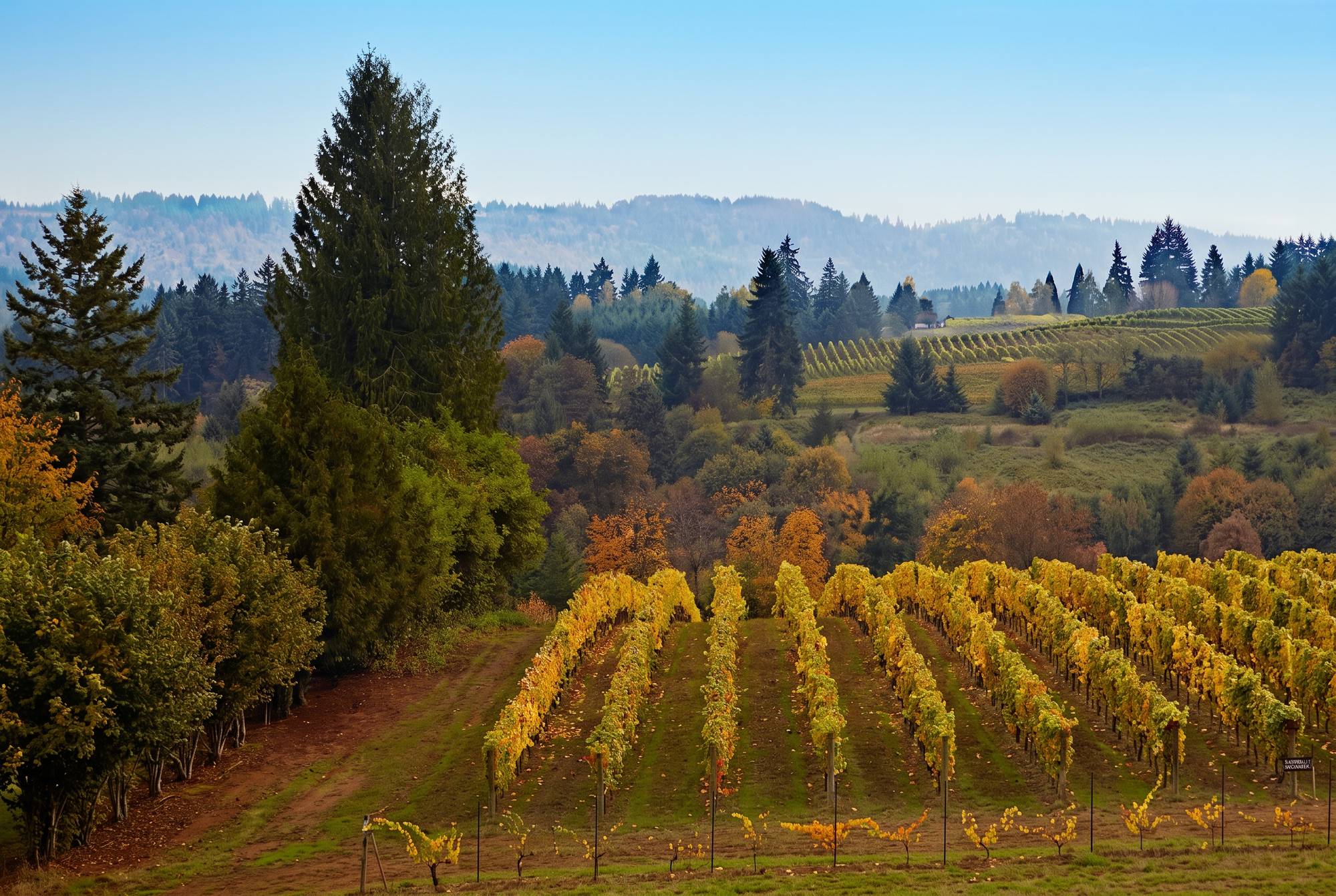
The Willamette Valley runs 150 miles (240 kilometers) south from Portland between two mountain ranges, and it is Pinot Noir country to a degree no other American region can match. The grape covers about 70 percent of its vineyards. Wineries here are mostly small, the climate is cool and marginal, and the wines are closer in spirit to Burgundy than to California. Around 700 wineries work the valley (2024), most of them family-scale, and two-thirds of Oregon’s entire wine industry sits inside its boundaries.
Country: United States
Main grapes: Pinot Noir, Pinot Gris, Chardonnay, Riesling
Signature styles: Elegant, earthy Pinot Noir; crisp Pinot Gris; traditional-method sparkling wine
Climate: Cool and wet in winter, dry and mild in summer, shielded by the Coast Range
Key appellations: Willamette Valley AVA plus 11 nested AVAs, including Dundee Hills, Eola-Amity Hills, and Yamhill-Carlton
Vineyard area: About 27,200 acres (11,000 hectares) as of 2024
2. Why It Matters
Pinot Noir is notoriously hard to grow well, and the Willamette Valley is one of the few places outside Burgundy that does it consistently. Since an Oregon Pinot embarrassed famous French bottles at a 1979 Paris tasting, the valley has become the American benchmark for the grape, and French producers, including Burgundy’s Drouhin family, have bought land here rather than compete from afar. The valley also set the template for American wine tourism at human scale, with tasting rooms where the person pouring often made the wine.
3. Land and Climate
Geography does the winemaking here. The Coast Range to the west absorbs Pacific storms, so the valley gets wet winters but reliably dry summers and autumns, exactly what thin-skinned Pinot Noir needs to avoid rot in the critical weeks before harvest. Summers are warm, not hot; days above 90°F (32°C) are rare, so grapes ripen slowly and keep their acidity and perfume.
The valley floor is fertile farmland, too rich for good wine, so nearly all vineyards climb the hillsides between about 200 and 1,000 feet (60 and 300 meters). Three soil types dominate: red volcanic Jory soil in the Dundee Hills, which gives bright red-fruited Pinot; ancient marine sediments around Yamhill-Carlton, which give darker, broader wines; and wind-deposited silt called loess. Producers bottle them separately, and you can taste the difference in the glass, which is exactly the point.
4. Grapes and Styles
Pinot Noir accounted for roughly 70 percent of the valley’s plantings in 2024, and the classic style sits between California’s ripeness and Burgundy’s restraint: cherry and raspberry fruit, notes of tea and damp earth, silky tannins, and moderate alcohol. Wines from the 11 nested AVAs vary noticeably, from the red-fruited charm of the Dundee Hills to the darker, more structured wines of Yamhill-Carlton.
Whites are rising fast and now cover a substantial minority of the valley’s vineyard land. Pinot Gris is the everyday white, dry and pear-scented, and Oregon grows more of it than any other state. Chardonnay is the ambitious one, taut and mineral in a style closer to Chablis than to California, and Willamette Chardonnay is now nearly as compelling as its Pinot Noir, often for less money. Riesling and Gamay fill the margins, and the valley’s cool climate has fueled a boom in traditional-method sparkling wine, made the same way as Champagne. Whatever the grape, the house style of the valley is restraint: alcohol usually stays under 14 percent, and oak is seasoning here rather than the main sauce, even in ambitious bottlings.
5. Reading the Label
“Willamette Valley” on a label means at least 85 percent of the grapes came from the AVA, the federally defined growing region. A nested name such as “Dundee Hills” means 85 percent from that smaller zone.
Oregon adds its own stricter rules. A wine labeled “Pinot Noir” in Oregon must contain at least 90 percent Pinot Noir, versus the 75 percent the federal government requires for most varietal wines elsewhere. Single-vineyard names on the front label are common and meaningful here, since most producers are small and site-obsessed. As anywhere in the US, “Reserve” has no legal force, though Oregon producers tend to use it more honestly than most.
6. A Short History
Experts said Oregon was too cold and wet for fine wine. David Lett ignored them and planted Pinot Noir at his Eyrie Vineyards in 1965; a cluster of like-minded growers followed. When Lett’s 1975 Pinot placed among top Burgundies at the 1979 Gault-Millau “Wine Olympics” in Paris, the valley’s reputation was made. It became an official AVA in 1983 and has since added 11 nested appellations.
Did You Know? At a 1979 Paris tasting of 330 wines, a Pinot Noir from Oregon’s Eyrie Vineyards placed among the top ten Pinots in the world. Burgundy’s Robert Drouhin was skeptical enough to stage a rematch in 1980; the Oregon wine finished second by a whisker, and Drouhin later bought Willamette land himself.
7. At the Table
Willamette Pinot Noir and salmon is the Pacific Northwest’s signature pairing, especially cedar-planked salmon, because the wine’s acidity refreshes the fish’s oils without any tannic clash. It is just as good with duck, roast pork, or dishes built on mushrooms. Serve it at 55 to 60°F (13 to 16°C); most bottles need no decanting, and good ones age gracefully for 10 to 20 years.
Pour Pinot Gris cold with Dungeness crab or Thai food, and try the sparkling wines with oysters. Local menus lean hard on hazelnuts, truffles, and berries, and the wines were, in effect, grown for them.
Links
Producers’ association (Willamette Valley Wineries Association): https://www.willamettewines.com
State wine institute (Oregon Wine Board): https://www.oregonwine.org
Federal AVA regulator (TTB): https://www.ttb.gov/regulated-commodities/beverage-alcohol/wine/american-viticultural-area-ava