

Melbourne's backyard grows Pinot Noir where cattle grazed for half a century.
1. At a Glance
The Yarra Valley begins less than an hour east of Melbourne, in Victoria. It was the state's first wine region, planted in 1838, then abandoned for two generations before a revival in the 1960s and 70s. Today it is Australia's flagship cool-climate district, defined by Pinot Noir, Chardonnay, and traditional-method sparkling wine, with elegant Shiraz and Cabernet in warmer corners and more than 80 wineries scattered among its hills.
Country: Australia
Main grapes: Pinot Noir, Chardonnay, Shiraz, Cabernet Sauvignon
Signature styles: Elegant Pinot Noir; taut Chardonnay; bottle-fermented sparkling wine
Climate: Cool; among the coolest of Victoria's regions, with varied altitude
Key appellations: Yarra Valley GI (registered 1996)
Vineyard area: About 7,010 acres (2,837 hectares), 2020 national vineyard scan
2. Why It Matters
The Yarra led Australia's turn toward finesse. When the country's reputation rested on big, warm-climate reds, Yarra producers such as Mount Mary, Yeringberg, and Coldstream Hills showed that Australia could do perfume, structure, and restraint with Pinot Noir and Chardonnay. Moet & Chandon chose the valley for its Australian sparkling house, Domaine Chandon, in the 1980s, and the region now sets national benchmarks for both still and sparkling cool-climate wine while ranking among the country's most visited wine regions.
3. Land and Climate
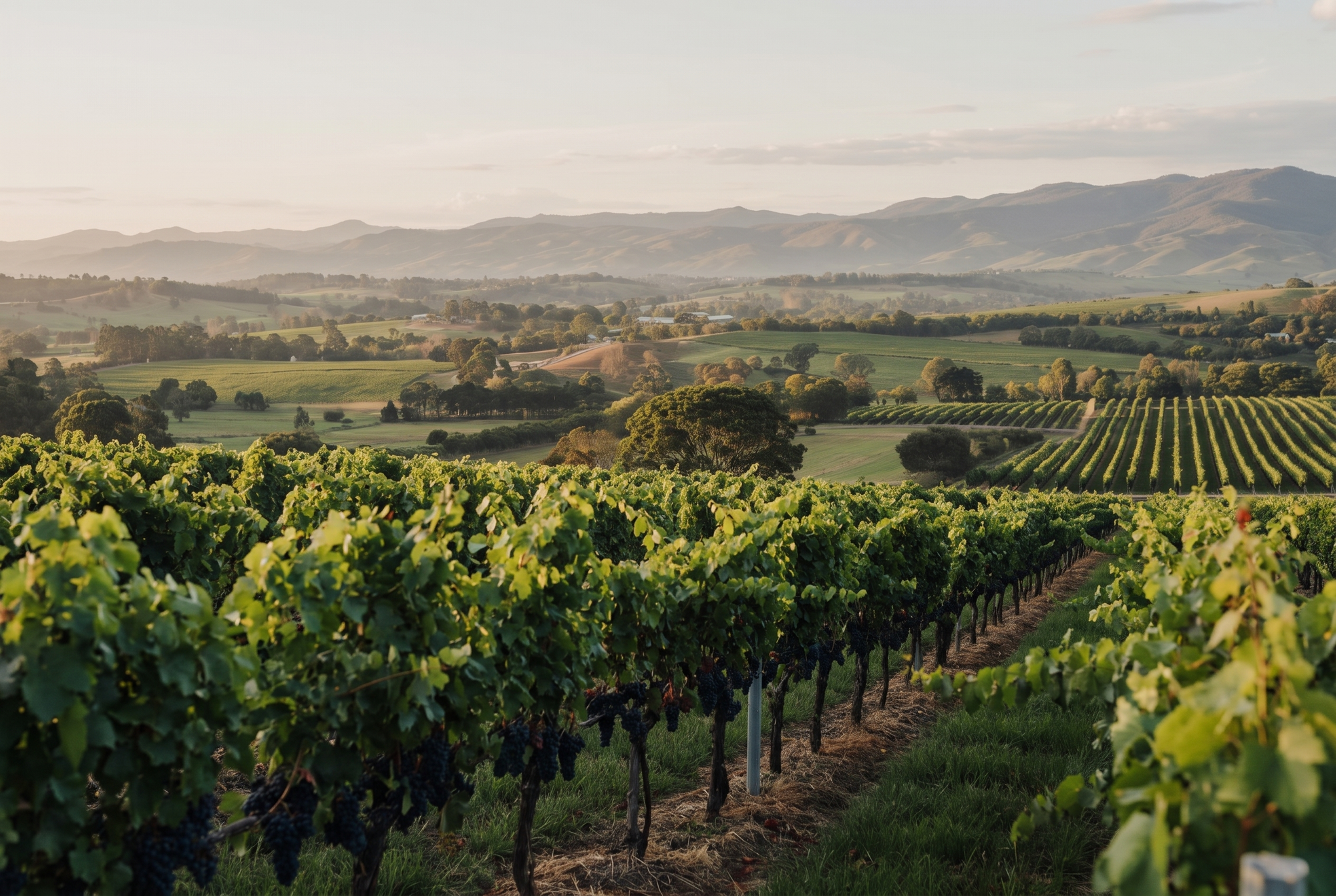
This is a large, varied region of hills, river flats, and forested ranges, with vineyards from roughly 160 to 1,300 feet (50 to 400 meters). Its mean January temperature of about 66 degrees Fahrenheit (18.9 Celsius) is among the lowest of Victoria's wine regions, which is precisely the point: slow ripening preserves the acidity and delicate aromatics that Pinot Noir and Chardonnay demand.
Altitude and aspect drive style. The warmer valley floor, with ancient gray-brown loams, ripens Shiraz and Cabernet; the cooler, higher Upper Yarra, on younger, fertile red volcanic soils, is prime Chardonnay and Pinot Noir ground and supplies much of the sparkling fruit. Growing-season rainfall of just under 24 inches (600 millimeters) allows some vineyards to farm without irrigation, a rarity in Australia. In cool, wet years, ripening Cabernet on the coldest sites is a genuine gamble, which is partly why Pinot Noir has taken over so much ground.
4. Grapes and Styles
Pinot Noir now leads plantings; together with Chardonnay it accounts for roughly three quarters of the harvest (regional figures, 2020s). Styles run from bright and cherry-fruited to savory and structured, generally medium-bodied with silky tannin, at their best with 5 to 10 years of age. Producers such as Mount Mary, Yeringberg, and Coldstream Hills set the benchmarks. Chardonnay is taut and citrusy, a far cry from the fat Australian Chardonnays of the 1990s, and the top wines age gracefully for a decade.
Sparkling wine is a regional strength and, in my view, still underrated by consumers who reflexively reach for Champagne. The best are made by the traditional method, meaning the bubbles come from a second fermentation inside the bottle, from Chardonnay and Pinot Noir grown on cold sites.
Warmer slopes give a distinctly cool-climate Shiraz, medium-bodied, peppery, and increasingly fashionable, along with Cabernet Sauvignon that is fragrant and firm rather than dense; the region's long-lived Cabernet blends were its 19th-century glory. Newer plantings of Nebbiolo, Gamay, and Arneis show the valley's experimental streak, and a busy scene of small producers keeps styles moving.
5. Reading the Label
"Yarra Valley" is a Geographical Indication, or GI, a legally protected regional name registered in 1996; at least 85 percent of the grapes must come from within it, and the same 85 percent minimum applies to any variety or vintage on the label. There are no official subregions, though "Upper Yarra" sometimes appears informally to signal a cooler, higher site.
On sparkling labels, look for "methode traditionnelle" or "traditional method," indicating bottle fermentation as in Champagne, and terms like "Blanc de Blancs" (all Chardonnay) or "late disgorged" (extra years resting on the spent yeast, called lees, which adds bready complexity). "NV" means a non-vintage blend of years, usually a house's entry point.
6. A Short History
The Ryrie brothers planted Victoria's first vines at Yering in 1838, and Swiss families, the de Castellas and de Purys, built a celebrated 19th-century industry around estates like St Huberts and Yeringberg. Changing tastes and economics killed it; by 1937 the last vineyards had been converted to grazing. Replanting began in the 1960s with new-generation estates, and by the 1990s the Yarra had reclaimed its place as Victoria's leading fine-wine region.
Did You Know? In 1889 the Yarra's Yering Station won a Grand Prix at the Paris Exhibition, still the only such award ever given to a Southern Hemisphere winery. Within five decades of that triumph the valley's wine industry was gone, its vineyards surrendered to dairy cattle until the 1960s revival.
7. At the Table
Yarra Pinot Noir is one of Australia's most food-friendly reds: duck, roast salmon, mushroom risotto, and turkey all work, and lighter examples can even take a slight chill in summer. Serve it slightly cool, about 57 to 61 degrees Fahrenheit (14 to 16 Celsius); a brief 20-minute decant helps very young bottles, while mature ones are better poured straight. Chardonnay pairs with roast chicken, scallops, and creamy pasta at around 52 degrees Fahrenheit (11 Celsius). The sparkling wines are ideal openers with oysters or fried snacks, well chilled to about 45 degrees Fahrenheit (7 Celsius). Good Pinot and Chardonnay here reward 5 to 10 years in the cellar; the everyday tiers are made for drinking now.
Links
Official regional body (Wine Yarra Valley): https://wineyarravalley.com.au/
Wine Australia regional profile: https://www.wineaustralia.com/market-insights/regions-and-varieties/victoria-wines/yarra-valley